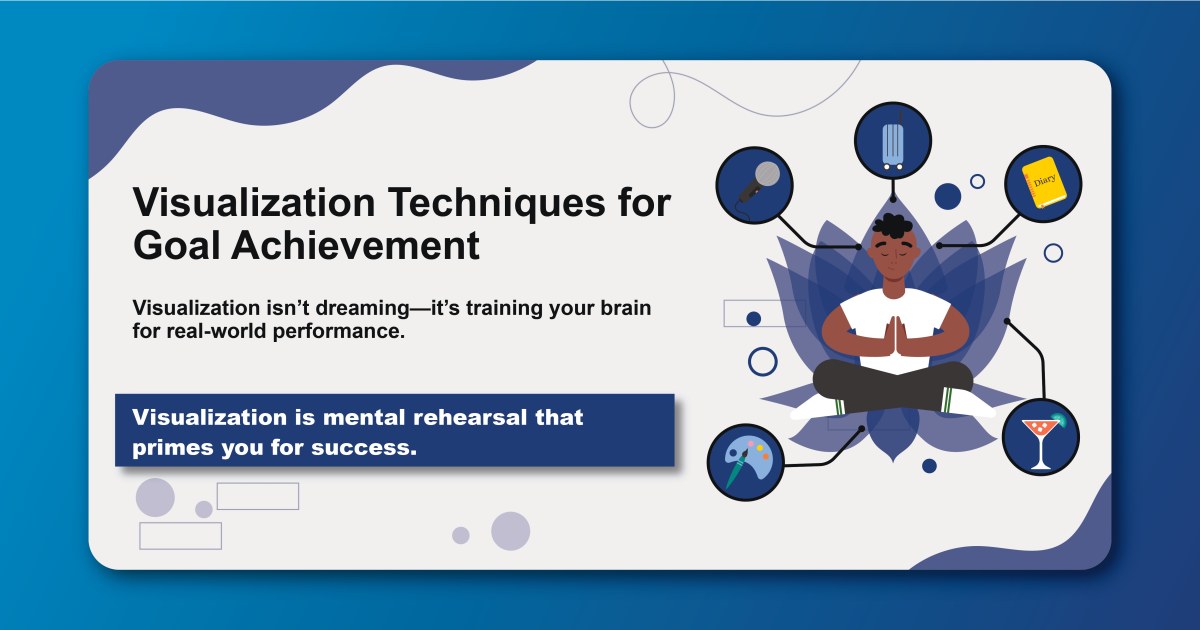
Olympic athletes do it before every competition. Elite performers use it to prepare for crucial presentations. Successful entrepreneurs employ it to envision their business outcomes. They're all harnessing one of the most powerful tools available to the human mind: visualization.
Visualization isn't just wishful thinking or positive psychology fluff. It's a scientifically proven technique that can dramatically improve your performance, increase your motivation, and accelerate your goal achievement. When you visualize effectively, you're literally rewiring your brain to support your success.
The power of visualization lies in the brain's inability to distinguish between vividly imagined experiences and real ones. When you visualize achieving your goals, your brain creates neural pathways similar to those formed by actual experience. This mental rehearsal prepares your mind and body for success, making achievement feel more familiar and attainable when you encounter real-world challenges.
But visualization isn't just about imagining success—it's about creating detailed mental experiences that engage all your senses, emotions, and cognitive processes. When done correctly, visualization becomes a powerful tool for building confidence, maintaining motivation, and developing the mental skills necessary for achievement.
The Science Behind Visualization
Neuroplasticity and Mental Rehearsal
How It Works: Your brain doesn't distinguish between real and vividly imagined experiences. When you visualize, you activate the same neural networks that would fire during actual performance.
Research Evidence: Studies show that mental practice can improve performance almost as much as physical practice. Basketball players who visualized free throws improved their accuracy by 23%, compared to 24% for those who practiced physically.
Practical Impact: Regular visualization literally rewires your brain to support your goals, making successful behaviors more automatic and natural.
The Reticular Activating System (RAS)
What It Is: The RAS is your brain's filtering system that determines what information gets your conscious attention.
How Visualization Helps: When you visualize your goals regularly, you program your RAS to notice opportunities, resources, and solutions related to your objectives.
Real-World Example: After visualizing your ideal job, you start noticing relevant job postings, networking opportunities, and skill development resources that were always there but previously filtered out.
Mirror Neurons and Performance
The Mechanism: Mirror neurons fire both when you perform an action and when you observe or imagine that action.
Visualization Benefit: Mental rehearsal through visualization activates these neurons, helping you develop skills and confidence without physical practice.
Application: Athletes use this to rehearse perfect technique, while professionals use it to practice presentations or difficult conversations.
Types of Visualization Techniques
1. Outcome Visualization
What It Is: Imagining yourself having achieved your goal and experiencing the results.
When to Use: For motivation, clarity, and maintaining focus on your desired outcome.
Example: Visualizing yourself crossing the finish line of a marathon, feeling the medal around your neck, and celebrating with family.
Benefits: Increases motivation, clarifies your "why," and helps maintain focus during challenging times.
2. Process Visualization
What It Is: Mentally rehearsing the specific steps and actions required to achieve your goal.
When to Use: For skill development, performance improvement, and building confidence.
Example: Visualizing yourself going through your morning routine, step by step, to establish a new habit.
Benefits: Improves actual performance, builds confidence, and makes execution feel more familiar.
3. Obstacle Visualization
What It Is: Imagining potential challenges and mentally rehearsing how you'll overcome them.
When to Use: For preparation, resilience building, and problem-solving.
Example: Visualizing yourself feeling tired during a workout but using your motivation strategies to push through.
Benefits: Increases resilience, prepares you for setbacks, and builds mental toughness.
4. Identity Visualization
What It Is: Imagining yourself as the type of person who has achieved your goal.
When to Use: For identity-based change and long-term transformation.
Example: Visualizing yourself as a confident speaker, seeing how you carry yourself and interact with others.
Benefits: Supports identity change, builds self-concept, and makes behaviors feel more natural.
The VIVID Visualization Framework
V - Visual Details
Principle: Create rich, detailed mental images that engage your visual system.
Application: See yourself in the environment where your goal will be achieved. Notice colors, lighting, spatial relationships, and visual details.
Example: If your goal is to give a presentation, visualize the conference room, the audience, your slides, and your body language.
I - Involve All Senses
Principle: Engage all five senses to create a complete sensory experience.
Application:
- Sight: What do you see when you achieve your goal?
- Sound: What sounds surround your success?
- Touch: What physical sensations do you feel?
- Smell: What scents are present in your success environment?
- Taste: Are there any taste associations with your achievement?
Example: Visualizing a successful business launch—seeing the packed venue, hearing applause, feeling the handshakes, smelling the catered food, tasting the celebration champagne.
V - Vivid Emotions
Principle: Feel the emotions you'll experience when you achieve your goal.
Application: Don't just see success—feel pride, joy, satisfaction, relief, or excitement. Make these emotions as real as possible.
Example: Feel the surge of confidence when you complete your first marathon, the pride in your accomplishment, and the joy of celebrating with supporters.
I - Incorporate Movement
Principle: Include physical movement and body awareness in your visualization.
Application: Feel your body moving, your posture changing, and your physical presence in the success scenario.
Example: Visualizing yourself walking confidently onto a stage, feeling your strong posture, and moving with purpose.
D - Detail and Duration
Principle: Make your visualization detailed and practice it for sufficient duration.
Application: Spend 10-20 minutes in detailed visualization, focusing on one aspect at a time before building the complete picture.
Example: First visualize just the environment, then add people, then add your actions, then add emotions, building a complete mental movie.
Practical Visualization Techniques
1. The Mental Movie Method
Setup: Create a detailed mental movie of your goal achievement from start to finish.
Process:
- Set aside 15-20 minutes in a quiet space
- Close your eyes and begin with the end result
- Work backward to include the journey
- Add sensory details, emotions, and movement
- "Watch" your movie from both first-person and third-person perspectives
Example: Mental movie of launching a successful business—from initial idea to grand opening, including all the steps, challenges overcome, and final celebration.
2. The Daily Success Rehearsal
Setup: Visualize your upcoming day going perfectly according to your goals.
Process:
- Each morning, spend 5-10 minutes visualizing your day
- See yourself completing goal-related tasks successfully
- Imagine overcoming any expected challenges
- Feel the satisfaction of a productive day
- End with visualizing yourself going to bed accomplished
Example: Visualizing a day of healthy eating, productive work, and exercise, seeing yourself making good choices and feeling energized.
3. The Skills Practice Visualization
Setup: Mentally rehearse specific skills or abilities you need to develop.
Process:
- Identify a specific skill related to your goal
- Visualize yourself performing this skill perfectly
- Include the physical sensations and mental state
- Practice different scenarios and variations
- Visualize improvement and mastery over time
Example: Visualizing yourself giving presentations, practicing different audiences, handling questions, and feeling increasingly confident.
4. The Obstacle Overcome Technique
Setup: Visualize potential challenges and your successful responses to them.
Process:
- Identify likely obstacles to your goal
- Visualize each obstacle arising
- See yourself responding calmly and effectively
- Imagine the strategies you'll use to overcome challenges
- Feel the confidence and resilience you'll maintain
Example: Visualizing yourself facing rejection from potential clients, maintaining composure, learning from feedback, and successfully closing the next opportunity.
5. The Future Self Visualization
Setup: Imagine yourself as the person who has already achieved your goal.
Process:
- Visualize yourself 6-12 months after achieving your goal
- See how you've changed and grown
- Feel the confidence and capabilities you've developed
- Imagine giving advice to your current self
- Connect with the identity of your successful future self
Example: Visualizing yourself as a successful entrepreneur, confident and skilled, remembering your journey and feeling grateful for your persistence.
Common Visualization Mistakes
Mistake 1: Vague or Generic Imagery
The Problem: Using unclear or generic mental images that lack detail and personal relevance.
Example: Simply imagining "being successful" without specific details about what success looks like for you.
Solution: Create specific, detailed visualizations that are personally meaningful and relevant to your unique goals.
Mistake 2: Focusing Only on Outcomes
The Problem: Visualizing only the end result without including the process or potential challenges.
Example: Only imagining winning the championship without visualizing the training, preparation, and obstacles.
Solution: Balance outcome visualization with process visualization and obstacle rehearsal.
Mistake 3: Passive Visualization
The Problem: Watching your visualization like a movie rather than actively experiencing it.
Example: Seeing yourself succeed from a distance rather than feeling the experience from your own perspective.
Solution: Engage actively in your visualization, experiencing it from the first-person perspective with all senses involved.
Mistake 4: Inconsistent Practice
The Problem: Visualizing occasionally or only when motivated, rather than making it a regular practice.
Example: Visualizing only when you feel like it or remember to do it.
Solution: Create a consistent visualization routine, preferably at the same time each day.
Mistake 5: Ignoring Negative Emotions
The Problem: Trying to force only positive emotions and avoiding realistic challenges in visualization.
Example: Refusing to visualize any difficulties or setbacks in your goal achievement.
Solution: Include realistic challenges and practice overcoming them, building mental resilience.
Advanced Visualization Strategies
1. Anchor Visualization
Concept: Connect your visualization to a physical anchor that you can access during real performance.
Process:
- Choose a simple physical gesture (touching thumb to index finger)
- Perform this gesture during successful visualizations
- Practice until the gesture automatically triggers confidence and success feelings
- Use the anchor during actual performance situations
Benefits: Provides instant access to your visualization state during real-world challenges.
2. Perspective Shifting
Concept: Practice visualizing from different perspectives to gain comprehensive understanding.
Perspectives:
- First-person: Your direct experience of success
- Third-person: Observing yourself succeed from outside
- Others' perspective: How others see your success
- Future perspective: Looking back on your achievement
Benefits: Builds comprehensive understanding and multiple motivational angles.
3. Time-Lapse Visualization
Concept: Visualize your progress over time, seeing the gradual development and growth.
Process:
- Start with your current state
- Visualize small improvements over days and weeks
- See major milestones being reached
- Watch your skills and confidence grow
- Arrive at your ultimate goal achievement
Benefits: Builds patience, realistic expectations, and long-term motivation.
4. Collaborative Visualization
Concept: Include others in your visualization, practicing social aspects of your goals.
Applications:
- Visualize team collaboration for business goals
- Include family support for personal goals
- Practice social situations related to your objectives
- Imagine mentoring others after your success
Benefits: Prepares you for the social aspects of achievement and builds relationship skills.
Building Your Visualization Practice
Week 1: Foundation Building
Days 1-2: Learn basic visualization techniques Days 3-4: Practice outcome visualization for your main goal Days 5-7: Add sensory details and emotional engagement
Week 2: Skill Development
Days 8-10: Practice process visualization for daily actions Days 11-12: Add obstacle visualization and problem-solving Days 13-14: Combine different visualization types
Week 3: Integration
Days 15-17: Develop your personal visualization routine Days 18-19: Practice anchor techniques and perspective shifting Days 20-21: Create your comprehensive visualization practice
Week 4: Optimization
Days 22-24: Refine your visualizations based on real-world feedback Days 25-26: Develop advanced techniques that work for you Days 27-28: Establish long-term visualization habits
Technology and Tools
Visualization Apps
Popular Options: Insight Timer, Headspace, Calm Features: Guided visualizations, customizable sessions, progress tracking
Audio Support
Binaural Beats: Frequencies that may enhance visualization effectiveness Nature Sounds: Background audio to enhance relaxation and focus Guided Scripts: Pre-recorded visualization sessions
Virtual Reality
Emerging Technology: VR environments for immersive visualization Applications: Practicing presentations, sports performance, phobia treatment Benefits: Enhanced realism and sensory engagement
Visualization is one of the most powerful tools available for goal achievement. When you combine clear mental imagery with emotional engagement and consistent practice, you create a mental blueprint for success that guides your actions and accelerates your progress.
Remember that visualization is a skill that improves with practice. Start with simple techniques, be patient with yourself, and gradually build more sophisticated visualization abilities. The key is consistency—regular visualization practice will compound over time, creating profound changes in your mindset, confidence, and ultimately, your results.
Your mind is incredibly powerful. When you learn to harness that power through visualization, you don't just imagine success—you create the mental conditions that make it inevitable.
Ready to harness the power of visualization for your goals? Track your progress and maintain motivation with Habityzer as you turn your mental imagery into real achievement.