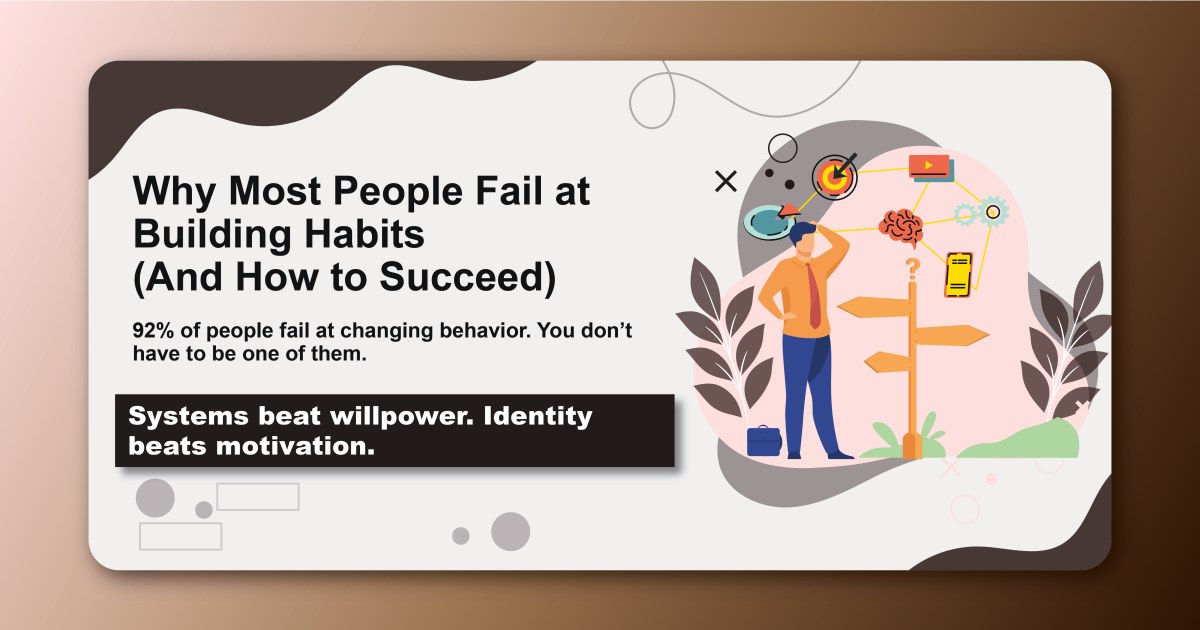
If you've ever tried to build a habit and failed, you're not alone. Studies show that 92% of people fail to achieve their behavior change goals. But here's the thing: it's not because you lack willpower or motivation. Most people fail because they make the same predictable mistakes.
In this guide, you'll discover the 7 most common reasons why habits fail and learn proven strategies to overcome each obstacle. By understanding these patterns, you can finally build the habits that will transform your life.
The Real Reason Most Habits Fail
Before we dive into the specific failures, let's address the fundamental misunderstanding that causes most habit attempts to fail: people focus on outcomes instead of systems.
When you say "I want to lose 20 pounds" or "I want to read 50 books this year," you're focused on the result. But habits are about the process, not the outcome. The people who succeed focus on becoming the type of person who naturally does these behaviors.
The 7 Most Common Habit Failures (And How to Fix Them)
1. Starting Too Big and Too Fast
The Problem: You decide to wake up at 5 AM, meditate for 30 minutes, work out for an hour, and read for 45 minutes—all starting tomorrow.
Why It Fails: Your brain resists dramatic changes. Large habits require significant willpower, which is a limited resource. When you try to change too much at once, you create cognitive overload and set yourself up for failure.
The Solution: Start ridiculously small
- Instead of 30 minutes of meditation, start with 2 minutes
- Instead of an hour workout, do 5 push-ups
- Instead of reading for 45 minutes, read 1 page
- Master one tiny habit before adding another
Success Strategy: Use the "2-minute rule"—can you do your habit in 2 minutes or less? If not, scale it down until you can.
2. Relying on Motivation Instead of Systems
The Problem: You feel inspired after watching a motivational video or reading a success story, so you commit to a new habit. But when the motivation fades (which it always does), the habit disappears too.
Why It Fails: Motivation is temporary and unreliable. It's influenced by your mood, energy levels, and circumstances. Successful habits don't depend on how you feel—they depend on systems that work regardless of your motivation.
The Solution: Create environment-based triggers
- Visual cues: Place your running shoes by your bed
- Time-based cues: Set specific times for habits
- Location cues: Designate specific places for behaviors
- Habit stacking: Link new habits to existing ones
Success Strategy: Design your environment so that the right choice is the easy choice, and the wrong choice requires more effort.
3. Focusing on the Habit, Not the Identity
The Problem: You try to force yourself to "do" a habit without considering who you need to "become" to maintain it naturally.
Why It Fails: Behaviors that conflict with your identity are difficult to maintain. If you see yourself as "not a morning person," you'll struggle with early morning habits. If you identify as "not athletic," exercise habits will feel forced.
The Solution: Start with identity change
- Instead of "I want to run," think "I am a runner"
- Instead of "I want to write," think "I am a writer"
- Instead of "I want to eat healthy," think "I am someone who takes care of their body"
Success Strategy: Ask yourself, "What would a [identity] person do?" Then do that, even if it's just for 2 minutes.
4. Not Tracking Progress
The Problem: You start a habit with good intentions but don't track your progress. Without measurement, you lose awareness of your consistency and can't identify patterns or problems.
Why It Fails: What doesn't get measured doesn't get managed. Without tracking, you can't see progress, celebrate wins, or identify what's working and what isn't.
The Solution: Use simple, immediate tracking
- Paper tracking: Mark an X on a calendar
- App tracking: Use tools like Habityzer for detailed analytics
- Visual tracking: Use a jar and move marbles from one side to the other
- Photo tracking: Take daily photos of your progress
Success Strategy: Track immediately after completing the habit, not at the end of the day. This creates an immediate reward loop.
5. Ignoring Environmental Design
The Problem: You try to build good habits in environments that support bad ones. You want to eat healthy but keep junk food in easy reach. You want to read more but leave your phone on the nightstand.
Why It Fails: Your environment is stronger than your willpower. If you have to rely on self-control every time you want to perform a habit, you'll eventually fail when your willpower is depleted.
The Solution: Design your environment for success
- Make good habits obvious: Place cues in your line of sight
- Make bad habits invisible: Remove temptations from your environment
- Make good habits easy: Reduce friction and barriers
- Make bad habits hard: Add friction to undesired behaviors
Success Strategy: Spend 10 minutes redesigning your environment to support your desired habits before you start trying to build them.
6. Not Planning for Obstacles
The Problem: You start strong but quit the moment you encounter a challenge. You miss one day and give up entirely, or you don't plan for travel, busy periods, or other disruptions.
Why It Fails: Life is unpredictable. If you don't have a plan for when things go wrong, you'll treat temporary setbacks as permanent failures.
The Solution: Create "if-then" plans
- If I'm traveling, then I'll do a 5-minute bodyweight workout in my hotel room
- If I'm sick, then I'll read just one paragraph to maintain the habit
- If I miss a day, then I'll get back on track immediately the next day
- If I'm stressed, then I'll do the minimum version of my habit
Success Strategy: Plan for your habit to be interrupted, not perfect. The goal is consistency, not perfection.
7. Trying to Change Everything at Once
The Problem: You get excited about self-improvement and try to build multiple habits simultaneously. You want to exercise, meditate, eat healthy, wake up early, and read more—all at the same time.
Why It Fails: Each habit requires attention and energy. When you try to build multiple habits at once, you spread your limited resources too thin and increase the likelihood of failure across all areas.
The Solution: Focus on one habit at a time
- Sequential habit building: Master one habit before adding another
- Habit stacking: Link new habits to ones you've already established
- Themed periods: Focus on health habits for a month, then productivity habits
- Keystone habits: Choose one habit that naturally supports others
Success Strategy: Resist the urge to do everything at once. Master one habit for at least 30 days before considering adding another.
The Psychology Behind Habit Failure
Understanding why these mistakes happen can help you avoid them:
The Planning Fallacy
We consistently underestimate how long tasks will take and overestimate our future motivation. This leads to unrealistic habit commitments.
The Intention-Action Gap
There's a significant difference between intending to do something and actually doing it. Good intentions don't automatically translate to consistent behavior.
The Fresh Start Effect
We tend to start new habits during temporal landmarks (New Year, Monday, birthdays) but don't plan for the motivation to fade.
The Success Formula That Actually Works
Here's the proven formula for building habits that stick:
1. Start Small (Minimum Viable Habit)
- Choose the smallest possible version of your desired habit
- Focus on consistency over intensity
- Build momentum before increasing difficulty
2. Stack It (Habit Stacking)
- Link your new habit to an existing one
- Use the formula: "After I [existing habit], I will [new habit]"
- Leverage established routines as triggers
3. Shape Your Environment
- Make cues for good habits obvious
- Remove cues for bad habits
- Design your space to support your goals
4. Track It Simply
- Use immediate, visual tracking
- Focus on consistency, not perfection
- Celebrate small wins
5. Plan for Failure
- Create minimum viable versions for tough days
- Develop comeback strategies
- Never miss twice in a row
Common Habit Myths That Lead to Failure
Myth 1: "It Takes 21 Days to Form a Habit"
Reality: Research shows it takes an average of 66 days, with a range of 18-254 days depending on the habit and individual.
Myth 2: "You Need Motivation to Build Habits"
Reality: Motivation starts habits, but systems maintain them. Focus on creating systems that work without motivation.
Myth 3: "Missing One Day Ruins Everything"
Reality: Habits are about long-term consistency, not perfection. One missed day doesn't matter if you get back on track quickly.
Myth 4: "Habits Should Feel Easy Immediately"
Reality: New habits often feel difficult at first. The key is making them simple enough to do consistently until they become automatic.
A Real-World Success Story
Let me share how Sarah, a busy marketing manager, went from multiple habit failures to sustainable success:
Previous Failures:
- Tried to wake up at 5 AM for 2-hour morning routines
- Attempted to meditate for 30 minutes daily
- Committed to 1-hour gym sessions 5 days a week
- All failed within 2 weeks
Successful Approach:
- Started small: 2 minutes of meditation after morning coffee
- Tracked simply: Used a phone app to mark completion
- Planned for obstacles: Had a 30-second breathing exercise for busy days
- Focused on identity: "I am someone who starts the day calmly"
Result: After 8 weeks, Sarah was consistently meditating 10-15 minutes daily and had added a 20-minute morning walk to her routine.
Your Habit Success Action Plan
Ready to succeed where others fail? Follow this step-by-step plan:
Week 1: Foundation
- Choose ONE habit to focus on
- Make it ridiculously small (2 minutes max)
- Link it to an existing habit
- Set up your environment for success
Week 2-3: Consistency
- Focus solely on showing up daily
- Track your progress immediately
- Celebrate every completion
- Don't increase difficulty yet
Week 4-6: Strengthening
- Continue daily practice
- Create backup plans for obstacles
- Notice how it's becoming easier
- Consider tiny increases if it feels effortless
Week 7-8: Integration
- The habit should feel more automatic
- Plan for long-term maintenance
- Only then consider adding a second habit
- Reflect on what you've learned
The Bottom Line
Most people fail at building habits because they:
- Start too big
- Rely on motivation
- Ignore identity
- Don't track progress
- Fight their environment
- Don't plan for obstacles
- Try to change everything at once
But now you know better. You understand that success comes from:
- Starting small
- Building systems
- Focusing on identity
- Tracking progress
- Designing your environment
- Planning for failure
- Changing one thing at a time
The people who succeed at building habits aren't more motivated or disciplined—they just understand how habits actually work and avoid the common pitfalls that trap everyone else.
Your past failures don't predict your future success. Armed with this knowledge, you can finally build the habits that will transform your life.
Start small. Start today. Start with just one habit.
Ready to track your habits and avoid the common failure patterns? Join Habityzer and discover how our system helps you build lasting habits using proven strategies that actually work.