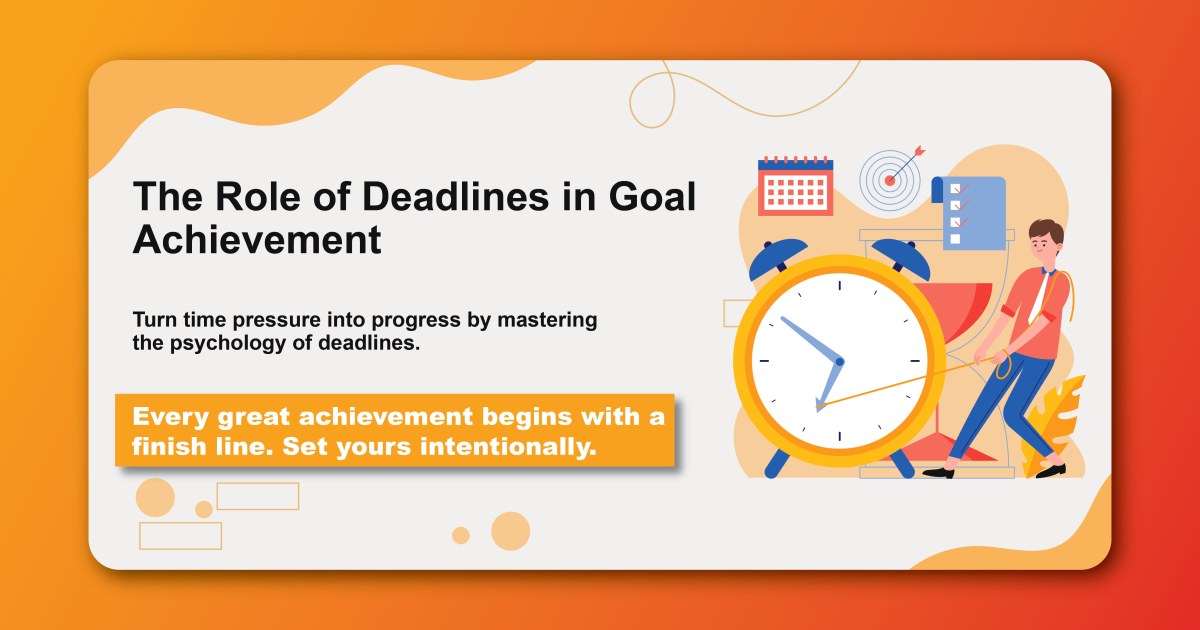
There's something magical about deadlines that transforms how we work and think. Without them, "someday" becomes the enemy of achievement, and our most important goals drift indefinitely into the future. With them, we suddenly find focus, energy, and creative solutions we didn't know we possessed.
Deadlines are more than just arbitrary dates on a calendar—they're psychological tools that can dramatically accelerate your progress toward any goal. When used strategically, deadlines create urgency, focus your attention, and activate cognitive systems that enhance performance. When used poorly, they create stress, panic, and suboptimal outcomes.
The key to harnessing the power of deadlines lies in understanding both their psychological effects and their practical applications. Effective deadlines don't just create pressure—they create productive pressure that channels your energy toward meaningful action and sustained progress.
Whether you're working toward personal goals, professional objectives, or creative projects, mastering the art of deadline creation and management can be the difference between chronic procrastination and consistent achievement.
The Psychology of Deadlines
Parkinson's Law in Action
The Principle: Work expands to fill the time available for its completion.
How It Works: Without deadlines, tasks that could be completed in hours stretch into days, weeks, or months. Deadlines create artificial scarcity that forces efficiency.
Real-World Example: A presentation that could be prepared in 4 hours might take 2 weeks if you give yourself that much time, but only 4 hours if that's all you have.
The Urgency Effect
The Mechanism: Deadlines activate your brain's urgency response, increasing focus and decision-making speed.
Neurological Impact: Time pressure triggers the release of stress hormones that enhance alertness and performance, similar to the "fight or flight" response.
Cognitive Benefits: Deadlines reduce overthinking and perfectionism, forcing you to focus on what's truly important.
Temporal Landmarks
The Concept: Deadlines serve as temporal landmarks that help you mentally organize time and create fresh starts.
Planning Benefits: They provide structure to your calendar and help you sequence activities logically.
Motivation Impact: Each deadline creates a mini-goal that provides regular opportunities for completion and celebration.
Types of Deadlines and Their Effects
1. Hard Deadlines
Definition: Non-negotiable deadlines with real consequences for missing them.
Examples:
- Tax filing deadline
- Project submission for work
- Event registration cutoff
- Application deadlines
Psychological Effect: Create maximum urgency and focus, but can also create stress and anxiety if unrealistic.
Best For: Tasks with external consequences, final deliverables, and situations requiring absolute commitment.
2. Soft Deadlines
Definition: Self-imposed deadlines without external consequences.
Examples:
- Personal project completion dates
- Habit formation timelines
- Learning goals
- Health and fitness targets
Psychological Effect: Provide structure and motivation while allowing flexibility for adjustment.
Best For: Personal development goals, creative projects, and long-term objectives.
3. Rolling Deadlines
Definition: Deadlines that move forward continuously, creating ongoing pressure.
Examples:
- Weekly review sessions
- Monthly progress reports
- Quarterly goal assessments
- Annual planning cycles
Psychological Effect: Maintain consistent momentum without the all-or-nothing pressure of fixed deadlines.
Best For: Ongoing processes, habit maintenance, and continuous improvement goals.
4. Milestone Deadlines
Definition: Intermediate deadlines that mark progress toward larger goals.
Examples:
- Monthly word count for writing a book
- Quarterly revenue targets for business growth
- Weekly fitness benchmarks
- Bi-weekly learning objectives
Psychological Effect: Provide regular feedback and maintain motivation through long-term projects.
Best For: Complex goals, long-term projects, and objectives requiring sustained effort.
Creating Effective Deadlines
The SMART-D Framework
S - Specific: Clear, unambiguous completion criteria M - Measurable: Quantifiable success indicators A - Achievable: Realistic given available time and resources R - Relevant: Aligned with your larger goals and priorities T - Time-bound: Specific date and time for completion D - Determined: Based on realistic assessment, not arbitrary selection
Deadline Setting Strategies
1. Backward Planning
- Start with your ultimate goal
- Work backward to identify key milestones
- Assign deadlines to each milestone
- Add buffer time for unexpected delays
Example: Book completion by December 31st
- December 15th: Final editing complete
- November 30th: First draft complete
- October 31st: 75% of chapters written
- September 30th: 50% of chapters written
- August 31st: Outline and research complete
2. The 80/20 Rule
- Identify the 20% of tasks that will create 80% of the impact
- Set aggressive deadlines for high-impact activities
- Allow more flexible deadlines for supporting tasks
3. Buffer Time Integration
- Add 25-50% buffer time to your initial estimates
- Account for unexpected obstacles and delays
- Include time for review and revision
- Plan for learning curves and skill development
4. Energy-Based Scheduling
- Align deadlines with your natural energy patterns
- Schedule demanding tasks during peak energy periods
- Allow longer timelines for low-energy periods
- Consider seasonal variations in motivation and capacity
The Benefits of Strategic Deadline Use
Enhanced Focus and Prioritization
How It Works: Deadlines force you to distinguish between essential and non-essential tasks.
Practical Impact: You naturally focus on activities that directly contribute to meeting your deadline, eliminating distractions and busywork.
Example: When you have a presentation deadline, you stop researching endlessly and start creating, focusing on the most important points.
Increased Motivation and Urgency
Psychological Mechanism: Deadlines activate approach motivation and create a sense of urgency that counteracts procrastination.
Behavioral Change: The approaching deadline makes the goal feel more real and immediate, increasing your commitment to action.
Long-term Effect: Regular use of deadlines builds a habit of taking action rather than delaying important tasks.
Improved Decision-Making
Cognitive Benefits: Time pressure reduces overthinking and analysis paralysis.
Decision Quality: While counter-intuitive, moderate time pressure often leads to better decisions by forcing you to focus on what matters most.
Speed vs. Quality: Deadlines help you find the optimal balance between speed and quality for each situation.
Better Time Estimation
Learning Effect: Regular deadline use improves your ability to estimate how long tasks actually take.
Planning Skills: You develop better intuition about realistic timelines and resource requirements.
Self-Awareness: You learn about your own working patterns, strengths, and limitations.
Common Deadline Mistakes and Solutions
Mistake 1: Unrealistic Deadlines
The Problem: Setting deadlines that require superhuman effort or ignore realistic constraints.
Signs: Consistently missing deadlines, requiring all-nighters, sacrificing quality for speed.
Solution: Track your actual completion times and build more realistic estimates. Add buffer time for unexpected delays.
Mistake 2: Too Many Deadlines
The Problem: Creating so many deadlines that they lose their urgency and effectiveness.
Signs: Feeling overwhelmed, regularly missing deadlines, inability to prioritize effectively.
Solution: Limit yourself to 2-3 major deadlines at any given time. Focus on the most important objectives.
Mistake 3: Arbitrary Deadlines
The Problem: Setting deadlines based on round numbers or external pressure rather than realistic assessment.
Signs: Deadlines that don't align with your actual capacity or the complexity of the task.
Solution: Base deadlines on careful planning and realistic assessment of time and resource requirements.
Mistake 4: All-or-Nothing Thinking
The Problem: Viewing missed deadlines as complete failures rather than learning opportunities.
Signs: Abandoning goals after missing deadlines, perfectionism, fear of setting new deadlines.
Solution: Treat missed deadlines as data points for better future planning. Focus on progress made rather than perfect completion.
Mistake 5: Ignoring External Factors
The Problem: Setting deadlines without considering external dependencies, resources, or constraints.
Signs: Deadlines that require cooperation from others who haven't committed, deadlines that ignore seasonal variations or external events.
Solution: Consider all external factors and dependencies when setting deadlines. Build in contingency plans.
Advanced Deadline Strategies
1. The Artificial Deadline Technique
Concept: Create personal deadlines that are earlier than the actual deadline to build in buffer time.
Implementation: If something is due Friday, set your personal deadline for Wednesday.
Benefits: Provides stress relief, allows time for unexpected issues, and often results in higher quality work.
2. Public Deadline Commitment
Concept: Announce your deadlines publicly to create social accountability.
Methods: Social media posts, blog announcements, telling friends and family.
Psychological Impact: Creates additional motivation through social pressure and public commitment.
3. Consequence-Based Deadlines
Concept: Attach meaningful consequences to your deadlines to increase motivation.
Positive Consequences: Rewards for meeting deadlines Negative Consequences: Donations to organizations you disagree with, public acknowledgment of missed deadlines
Implementation: Work with an accountability partner to enforce consequences.
4. Graduated Deadline Pressure
Concept: Start with low-pressure deadlines and gradually increase urgency as you approach the final deadline.
Example Timeline:
- 30 days out: Gentle reminder deadline
- 14 days out: Moderate pressure deadline
- 7 days out: High pressure deadline
- 1 day out: Final deadline
Benefits: Maintains motivation throughout the process while building intensity as needed.
Deadline Management Tools and Techniques
Digital Tools
Calendar Applications:
- Google Calendar: Deadline tracking with reminders
- Outlook: Integrated task and deadline management
- Apple Calendar: Simple deadline tracking with notifications
Project Management Platforms:
- Asana: Deadline tracking with team collaboration
- Trello: Visual deadline management with boards
- Monday.com: Comprehensive deadline and project tracking
Specialized Deadline Apps:
- Todoist: Task management with deadline functionality
- Any.do: Simple deadline tracking with reminders
- TickTick: Deadline management with calendar integration
Analog Methods
Physical Calendars:
- Wall calendars for visual deadline tracking
- Desk calendars for daily deadline awareness
- Pocket calendars for portable deadline management
Planning Systems:
- Bullet journaling with deadline tracking
- Planner systems with deadline integration
- Whiteboard deadline tracking for teams
Hybrid Approaches
Digital-Analog Combination:
- Digital planning with physical reminders
- Calendar apps with written deadline lists
- Project management tools with physical progress tracking
Building Your Deadline System
Step 1: Audit Your Current Approach
Questions to Consider:
- How do you currently handle deadlines?
- What works well in your current system?
- Where do you struggle with deadline management?
- What are your patterns of success and failure?
Step 2: Design Your Ideal System
Components to Include:
- Deadline setting methodology
- Tracking and reminder systems
- Progress monitoring tools
- Adjustment and learning processes
Step 3: Start Small and Build
Initial Implementation:
- Begin with one or two important deadlines
- Use simple tools and systems
- Focus on developing consistent habits
- Gradually add complexity as you build competence
Step 4: Monitor and Adjust
Regular Review:
- Weekly assessment of deadline progress
- Monthly evaluation of system effectiveness
- Quarterly adjustments based on learning
- Annual review of overall deadline strategy
Deadlines are powerful tools for goal achievement when used strategically and thoughtfully. They create urgency, focus attention, and provide structure that transforms vague aspirations into concrete achievements. The key is to view deadlines not as arbitrary constraints but as strategic tools that enhance your performance and accelerate your progress.
Remember that effective deadline management is a skill that improves with practice. Start with realistic deadlines for important goals, build systems that support your success, and learn from both your successes and setbacks. When you master the art of deadline creation and management, you gain a powerful tool for turning your goals into reality.
The difference between people who achieve their goals and those who don't is often not talent or resources—it's the strategic use of time constraints that create focus, urgency, and momentum. Use deadlines wisely, and watch your goal achievement accelerate dramatically.
Ready to harness the power of deadlines for your goals? Create strategic deadlines and track your progress with Habityzer and experience how effective time constraints can transform your achievement and productivity.