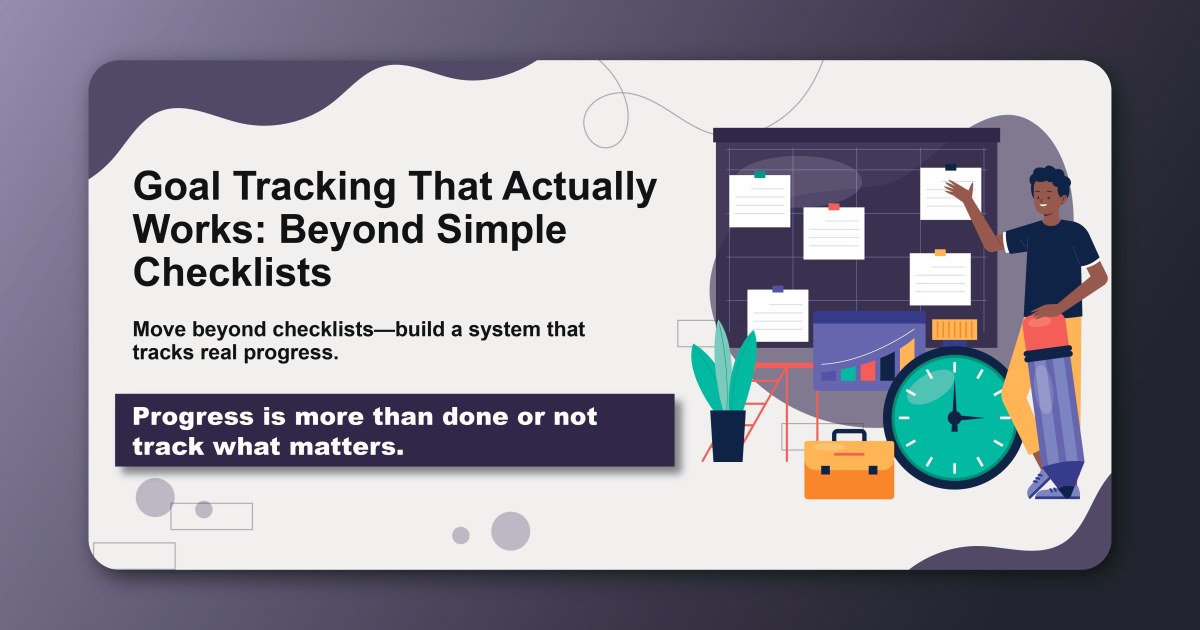
Most people's goal tracking looks something like this: a simple checklist with items like "Exercise today ✓" or "Read for 30 minutes ✓." While checklists have their place, they're often insufficient for meaningful progress tracking. They tell you what you did, but they don't tell you why it mattered, how it felt, or whether you're actually moving closer to your larger objectives.
The problem with basic goal tracking isn't that it's wrong—it's that it's incomplete. A simple check mark doesn't capture the complexity of real progress. It doesn't account for quality, context, learning, or the multifaceted nature of meaningful achievement.
What if your goal tracking could do more than just record completion? What if it could provide insights into your patterns, motivate you through difficult periods, help you course-correct when you're off track, and even predict future success? What if your tracking system could become a tool for continuous improvement rather than just a record of what you've done?
This is the difference between tracking and intelligent tracking. It's the difference between data collection and meaningful measurement. It's the difference between knowing what you did and understanding how you're progressing toward who you want to become.
The Problems with Simple Checklists
1. Binary Thinking
The Problem: Checklists create an all-or-nothing mentality. You either checked the box or you didn't, which doesn't reflect the reality of progress.
Real Life Example: You planned to exercise for 60 minutes but only had time for 20 minutes. A checklist marks this as a failure, but 20 minutes is still valuable progress.
The Impact: This binary thinking can lead to discouragement and the abandonment of goals when partial progress isn't recognized or valued.
2. No Context or Quality Measurement
The Problem: Checklists don't capture the quality, intensity, or context of your actions.
Real Life Example: "Read for 30 minutes" could mean actively engaging with challenging material or passively skimming easy content. The checklist treats them equally.
The Impact: Without context, you can't identify what's working best or learn from your most effective efforts.
3. Lack of Emotional and Motivational Insight
The Problem: Checklists don't track how you feel about your progress or what motivates you.
Real Life Example: You might consistently check off "meditation" but not notice that morning sessions leave you energized while evening sessions feel forced.
The Impact: Missing emotional patterns means missing opportunities to optimize your approach for better results and sustainability.
4. No Connection to Larger Purpose
The Problem: Checklists focus on activities without connecting them to your deeper goals and values.
Real Life Example: You check off "networking event attended" without considering whether these events are actually building the relationships you want.
The Impact: You can be busy without being effective, completing tasks without making meaningful progress.
5. Limited Learning and Adaptation
The Problem: Checklists don't capture lessons learned or insights that could improve future performance.
Real Life Example: You consistently miss your weekly planning session but don't track why or what alternatives might work better.
The Impact: You repeat the same mistakes without learning from them or adapting your approach.
The Elements of Intelligent Goal Tracking
1. Multi-Dimensional Progress Tracking
Beyond Binary: Instead of just "done" or "not done," track multiple dimensions of progress:
Quantity: How much did you do? Quality: How well did you do it? Consistency: How regularly are you doing it? Intensity: How much effort did you put in? Efficiency: How long did it take? Satisfaction: How did it feel?
Example: Exercise Tracking
- Duration: 45 minutes
- Intensity: 7/10
- Type: Strength training
- Energy after: 8/10
- Consistency: 4th workout this week
- Notes: New personal record on deadlift
2. Leading and Lagging Indicators
Leading Indicators: Activities and behaviors that predict future success Lagging Indicators: Outcomes and results that show what already happened
Example: Weight Loss Goal
- Leading: Calories tracked, workouts completed, sleep quality, stress levels
- Lagging: Pounds lost, body fat percentage, clothing size
Why This Matters: Leading indicators help you adjust your approach before problems become entrenched. Lagging indicators confirm whether your strategies are working.
3. Contextual Information
Environmental Factors: Where and when you perform best Emotional State: How you feel before, during, and after External Circumstances: What helps or hinders your progress Energy Levels: When you have the most and least energy
Example: Writing Goal Tracking
- Time: 6:00 AM - 7:00 AM
- Location: Home office
- Energy before: 8/10
- Distractions: None
- Word count: 750
- Quality self-rating: 7/10
- Mood after: Accomplished and energized
4. Learning and Insight Capture
What Worked: Specific strategies, tactics, or approaches that were effective What Didn't: Obstacles, failures, or ineffective methods Discoveries: New insights about yourself, your process, or your goals Adjustments: Changes you want to make based on what you learned
Example: Networking Goal
- Event: Industry conference
- New connections: 3 meaningful conversations
- What worked: Asking about challenges rather than pitching
- What didn't: Staying too long at formal presentations
- Insight: People respond better to genuine curiosity than sales pitches
- Adjustment: Focus on smaller, more intimate gatherings
5. Progress Toward Identity
Identity Alignment: How your actions align with who you want to become Character Development: What traits and habits you're building Values Expression: How your actions reflect your values Role Modeling: Whether you're becoming someone others could learn from
Example: Leadership Development
- Action: Led team meeting
- Identity development: Becoming more decisive and clear in communication
- Values expressed: Transparency, respect for others' time
- Character traits practiced: Patience, active listening
- Role model assessment: Would I want to work for someone who leads meetings like this?
Advanced Tracking Methods
1. The Dashboard Approach
Concept: Create a visual dashboard that shows multiple metrics at once, like a car dashboard shows speed, fuel, and engine temperature simultaneously.
Components:
- Key Performance Indicators (KPIs)
- Trend lines showing progress over time
- Warning indicators for areas needing attention
- Celebration markers for achievements
Example: Health and Fitness Dashboard
- Weight trend (30-day moving average)
- Workout frequency (weekly)
- Energy levels (daily rating)
- Sleep quality (7-day average)
- Nutrition score (weekly)
- Stress levels (daily rating)
Tools: Spreadsheets, apps like Notion or Airtable, or specialized tracking software
2. The Narrative Method
Concept: Track your goals through storytelling, capturing the journey, challenges, and growth along the way.
Components:
- Daily or weekly narrative entries
- Character development (how you're changing)
- Plot progression (major milestones and setbacks)
- Themes and lessons learned
- Future story arc planning
Example: Career Development Narrative "Week 12: This week I faced my first major presentation to senior leadership. I prepared extensively, practicing with my mentor Sarah. The presentation went well, and I received positive feedback about my data analysis. I'm noticing that I'm becoming more confident in my expertise and better at communicating complex ideas simply. Next week, I'll apply this confidence to the cross-functional project I'm leading."
3. The Habit Stack Analysis
Concept: Track not just individual habits, but how they connect and reinforce each other.
Components:
- Primary habit tracking
- Secondary habit triggers
- Compound effect measurement
- System synergy analysis
- Habit relationship mapping
Example: Morning Routine Stack
- 5:30 AM: Wake up (success rate: 85%)
- 5:35 AM: Drink water (triggered by waking, success rate: 90%)
- 5:40 AM: Meditation (triggered by water, success rate: 75%)
- 6:00 AM: Exercise (triggered by meditation, success rate: 80%)
- 6:45 AM: Healthy breakfast (triggered by exercise, success rate: 95%)
Analysis: The chain is weakest at meditation, and when meditation is skipped, exercise success drops to 40%.
4. The Seasonal Review Method
Concept: Track progress over different time horizons with different focuses for each.
Time Horizons:
- Daily: Energy, mood, key activities
- Weekly: Patterns, achievements, challenges
- Monthly: Trends, major milestones, system adjustments
- Quarterly: Strategic review, goal alignment, major changes
- Annually: Identity development, life satisfaction, direction changes
Example: Learning Goal Seasonal Review
- Daily: Study time, focus quality, energy levels
- Weekly: Concepts mastered, practice exercises completed
- Monthly: Skill assessments, project progress, learning methods effectiveness
- Quarterly: Curriculum adjustments, career relevance, future learning path
- Annually: Expertise development, professional growth, next year's focus
5. The Feedback Loop Integration
Concept: Build multiple feedback loops into your tracking system to ensure continuous improvement.
Types of Feedback:
- Self-assessment: Your own evaluation of progress and satisfaction
- Peer feedback: Input from friends, family, or colleagues
- Expert feedback: Guidance from mentors, coaches, or professionals
- Environmental feedback: Results from your environment and circumstances
- Data feedback: Objective metrics and measurements
Example: Public Speaking Goal
- Self-assessment: Comfort level, preparation quality, performance satisfaction
- Peer feedback: Audience engagement, clarity of message, delivery effectiveness
- Expert feedback: Professional speaking coach evaluation
- Environmental feedback: Venue acoustics, audience size, technology issues
- Data feedback: Speaking time, pause frequency, audience retention
Technology and Tools for Advanced Tracking
1. Spreadsheet-Based Systems
Advantages: Highly customizable, powerful analysis capabilities, familiar interface Best For: People who enjoy data manipulation and want complete control
Advanced Features:
- Conditional formatting for visual progress indicators
- Charts and graphs for trend analysis
- Formula-based calculations for complex metrics
- Data validation for consistent input
- Pivot tables for multi-dimensional analysis
Example Template Structure:
- Daily inputs: Date, activity, quantity, quality, context
- Weekly summaries: Averages, trends, patterns
- Monthly analysis: Progress toward goals, adjustments needed
- Quarterly reviews: Strategic assessment, goal evolution
2. Specialized Tracking Apps
Advantages: Designed specifically for goal tracking, often include motivational features Best For: People who want streamlined, mobile-friendly tracking
Popular Options:
- Habitica: Gamified habit tracking with RPG elements
- Strava: Athletic performance tracking with social features
- Forest: Focus and productivity tracking with environmental themes
- Toggl: Time tracking with detailed analysis
- MyFitnessPal: Health and nutrition tracking with extensive database
Advanced Features to Look For:
- Custom metrics and categories
- Trend analysis and reporting
- Integration with other apps and devices
- Social features for accountability
- Export capabilities for deeper analysis
3. Quantified Self Platforms
Advantages: Comprehensive life tracking across multiple domains Best For: People who want to optimize multiple areas of life simultaneously
Popular Platforms:
- Exist: Integrates data from multiple sources for comprehensive tracking
- Gyroscope: Creates beautiful visualizations of life data
- Rescue Time: Automatic time tracking and productivity analysis
- Oura Ring: Comprehensive health and activity tracking
- Apple Health/Google Fit: Ecosystem integration for health data
Data Sources:
- Wearable devices (fitness trackers, smartwatches)
- Smartphone sensors (location, screen time, activity)
- Calendar and email analysis
- Financial transaction data
- Social media activity
4. Custom Dashboard Solutions
Advantages: Tailored to your specific needs and preferences Best For: People with technical skills who want maximum customization
Tools for Building:
- Notion: Flexible database and dashboard creation
- Airtable: Spreadsheet-database hybrid with dashboard features
- Tableau: Professional data visualization and analysis
- Power BI: Business intelligence with personal applications
- Custom coding: Python, R, or web development for complete control
Dashboard Elements:
- Key Performance Indicators (KPIs)
- Progress charts and trend lines
- Heatmaps for pattern identification
- Goal completion percentages
- Streak counters and consistency metrics
Common Tracking Mistakes and Solutions
Mistake 1: Tracking Too Much
The Problem: Trying to track every possible metric leads to overwhelm and abandonment.
The Solution: Start with 3-5 key metrics that directly relate to your most important goals. Add complexity gradually.
Example: Instead of tracking 15 health metrics, start with weight, exercise frequency, and energy level.
Mistake 2: Tracking Too Little
The Problem: Minimal tracking provides insufficient data for meaningful insights and course correction.
The Solution: Ensure you're tracking both inputs (actions) and outputs (results), with at least one qualitative measure.
Example: Instead of just tracking "worked out," track duration, type, intensity, and how you felt.
Mistake 3: Inconsistent Tracking
The Problem: Irregular tracking creates gaps in data and makes pattern identification difficult.
The Solution: Build tracking into your daily routine and use reminder systems to maintain consistency.
Example: Set a daily phone reminder to complete your tracking at the same time each day.
Mistake 4: Tracking Without Review
The Problem: Collecting data without analyzing it wastes time and misses opportunities for improvement.
The Solution: Schedule regular review sessions (weekly, monthly, quarterly) to analyze your data and make adjustments.
Example: Sunday evening review of the week's progress and planning for the following week.
Mistake 5: Perfectionism in Tracking
The Problem: Trying to track perfectly creates pressure and often leads to abandonment when you miss entries.
The Solution: Accept that tracking will be imperfect and focus on consistency over perfection.
Example: If you miss a day, don't try to retroactively fill in data. Just resume tracking the next day.
Building Your Advanced Tracking System
Step 1: Goal and Metric Selection
Primary Goals: Identify your 2-3 most important goals Key Metrics: Choose 3-5 metrics per goal that truly matter Leading Indicators: Identify actions that predict success Lagging Indicators: Define outcomes that show results
Step 2: System Design
Tracking Method: Choose your platform and tools Data Collection: Determine what, when, and how you'll track Analysis Schedule: Plan regular review and analysis sessions Adjustment Protocol: Create a process for making changes
Step 3: Implementation
Start Simple: Begin with basic tracking and add complexity gradually Build Habits: Integrate tracking into your daily routine Test and Refine: Experiment with different approaches and metrics Stay Flexible: Be willing to adjust your system as you learn
Step 4: Optimization
Pattern Recognition: Look for trends and insights in your data Correlation Analysis: Identify relationships between different metrics Predictive Insights: Use your data to predict future performance Continuous Improvement: Regularly refine your tracking system
Effective goal tracking is an art that combines data collection with insight generation. It's about creating a system that not only records what you do but helps you understand why you do it, how you can do it better, and how you're progressing toward who you want to become.
The key is to move beyond simple checklists to create a tracking system that provides meaningful feedback, captures the complexity of real progress, and supports continuous improvement. When you track intelligently, you don't just record your journey—you optimize it.
Start with your most important goal, identify the metrics that truly matter, and build a tracking system that serves your growth. Remember, the best tracking system is one you'll actually use consistently, so start simple and evolve your approach as you learn what works best for you.
Ready to create intelligent goal tracking that drives real progress? Build comprehensive tracking systems with Habityzer and experience how advanced monitoring can accelerate your achievement and growth.