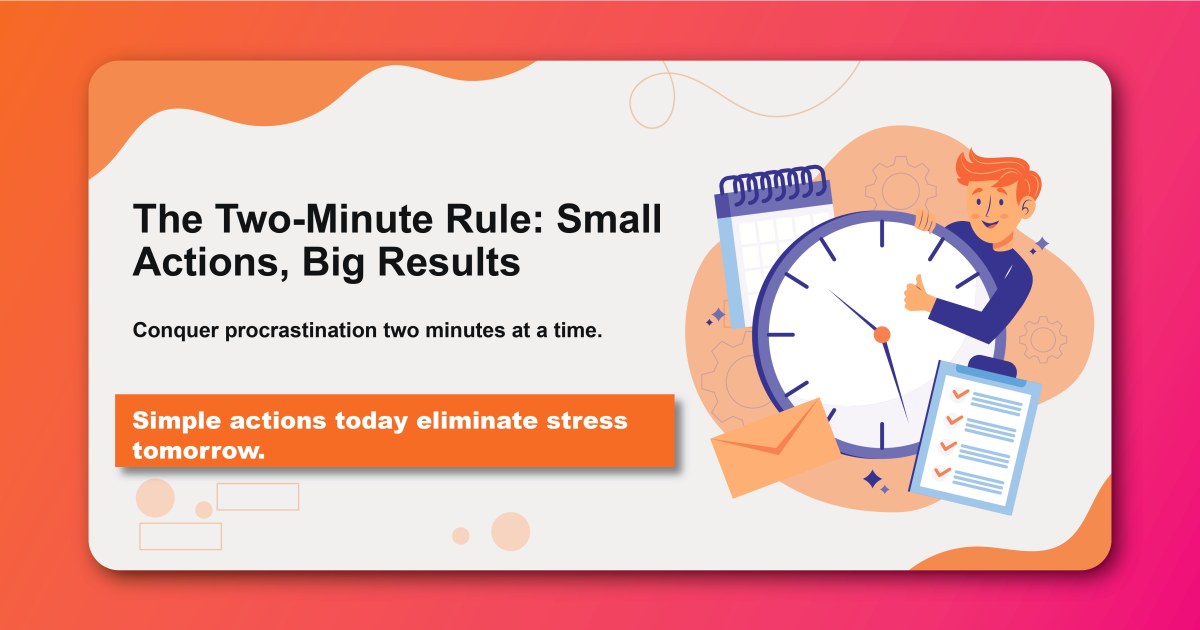
In the world of productivity, few concepts are as simple yet transformative as the two-minute rule. This deceptively straightforward principle—if something takes less than two minutes, do it now—has the power to eliminate overwhelm, reduce procrastination, and create remarkable momentum in your daily life.
First popularized by productivity expert David Allen in his "Getting Things Done" methodology, the two-minute rule addresses one of the most common productivity challenges: the accumulation of small tasks that gradually create overwhelming to-do lists. These micro-tasks, individually insignificant, collectively consume mental energy and create a constant background noise of unfinished business.
But what makes the two-minute rule so powerful isn't just its simplicity—it's the psychological and practical benefits that compound over time. When you consistently apply this rule, you don't just complete more tasks; you transform your relationship with action, decision-making, and momentum.
The Psychology Behind the Two-Minute Rule
The Cognitive Load of Unfinished Tasks
The Zeigarnik Effect Psychologist Bluma Zeigarnik discovered that our brains are wired to remember incomplete tasks more vividly than completed ones. Every small, unfinished task creates a mental "open loop" that consumes cognitive resources, even when we're not actively thinking about it.
Decision Fatigue Prevention Each unfinished task represents a decision that must be made later. By handling two-minute tasks immediately, you eliminate numerous future decisions, preserving mental energy for more important choices.
Attention Residue Small, pending tasks create what researchers call "attention residue"—a portion of your mental capacity that remains focused on the unfinished task. This residue reduces your ability to concentrate fully on current work.
The Momentum Psychology
The Starting Effect Action begets action. When you immediately tackle small tasks, you build momentum that carries over to larger projects. This creates a positive feedback loop where productivity builds on itself.
The Progress Principle Research by Harvard Business School's Teresa Amabile shows that making progress on meaningful work is the most powerful motivator. The two-minute rule provides frequent opportunities to experience progress, boosting motivation and engagement.
Confidence Building Each completed two-minute task is a small victory that builds confidence and reinforces your identity as someone who takes action. This self-perception becomes a powerful driver of future behavior.
The Original Two-Minute Rule
David Allen's Framework
The Core Principle When processing emails, tasks, or any input, if something can be done in two minutes or less, do it immediately rather than adding it to your to-do list.
The Logic It takes nearly as much time to add a task to your system, track it, and eventually get back to it as it does to simply complete it immediately. The two-minute rule eliminates this overhead.
The Context The rule applies specifically during processing sessions—when you're going through emails, reviewing tasks, or handling inputs. It's not about dropping everything to handle two-minute tasks that pop up randomly.
When to Apply the Original Rule
Email Processing
- Quick replies to simple questions
- Forwarding emails to appropriate people
- Filing or deleting emails
- Adding calendar events from invitations
Task Management
- Returning quick phone calls
- Scheduling appointments
- Updating project statuses
- Organizing files or materials
Administrative Work
- Paying bills online
- Responding to simple requests
- Updating contact information
- Booking reservations or appointments
Expanding the Two-Minute Rule
The Habit Formation Two-Minute Rule
James Clear's Adaptation Author James Clear adapted the two-minute rule for habit formation: when starting a new habit, scale it down to something that takes less than two minutes to complete.
The Principle The goal isn't to stick to two minutes forever but to establish the habit of showing up. Once the habit is established, you can gradually expand it.
Examples:
- "Read for 30 minutes" becomes "Read one page"
- "Exercise for an hour" becomes "Put on workout clothes"
- "Meditate for 20 minutes" becomes "Sit on meditation cushion"
- "Write a blog post" becomes "Write one sentence"
The Maintenance Two-Minute Rule
Preventing Accumulation Use two-minute actions to prevent problems from growing larger:
- Wash dishes immediately after eating
- File documents as soon as you're done with them
- Respond to texts within a reasonable timeframe
- Tidy up spaces as you use them
The Compound Effect Small maintenance actions prevent the need for larger cleanup sessions later. This creates more time and mental space for important work.
Strategic Applications of the Two-Minute Rule
Digital Life Management
Email Optimization
- Set up auto-replies for common inquiries
- Unsubscribe from unwanted newsletters immediately
- Delete spam and irrelevant emails on sight
- Use filters to automatically sort incoming messages
Social Media and Communication
- Respond to simple messages immediately
- Like or comment on posts you enjoy
- Share useful content with appropriate people
- Update your status or profile information
File and Document Management
- Rename files with descriptive names immediately
- Move files to appropriate folders
- Delete unnecessary screenshots or downloads
- Update bookmarks and remove dead links
Physical Environment
Workspace Maintenance
- Clear your desk at the end of each workday
- File papers immediately after use
- Wipe down surfaces after meals or work
- Organize supplies after using them
Home Management
- Make beds immediately after getting up
- Wash dishes after meals
- Put items back where they belong
- Wipe down bathroom surfaces after use
Personal Development
Learning and Growth
- Read one article on a topic you're interested in
- Watch one educational video
- Practice one new skill for two minutes
- Review and update your goals
Health and Wellness
- Do two minutes of stretching
- Take a short walk
- Practice deep breathing
- Drink a glass of water
Common Misapplications and How to Avoid Them
Misapplication 1: The Interruption Trap
The Problem: Dropping important work to handle every two-minute task that comes up The Solution: Apply the rule only during designated processing times
Strategy: Schedule specific times for processing emails, messages, and tasks. During focused work, note two-minute tasks for later processing.
Misapplication 2: The Perfectionism Trap
The Problem: Spending more than two minutes on "two-minute" tasks The Solution: Set strict time limits and accept "good enough"
Strategy: Use a timer and stick to the limit. Remember that the goal is progress, not perfection.
Misapplication 3: The Avoidance Trap
The Problem: Using two-minute tasks to avoid important but challenging work The Solution: Balance immediate actions with scheduled deep work
Strategy: Limit two-minute task sessions to specific timeframes. Don't let them consume your entire day.
Misapplication 4: The Overwhelm Trap
The Problem: Trying to apply the rule to everything simultaneously The Solution: Start with one area and expand gradually
Strategy: Begin with email management, then expand to other areas once the habit is established.
Building Your Two-Minute Rule Practice
Week 1: Foundation Building
Choose Your Starting Point
- Select one area to focus on (email, tasks, or maintenance)
- Set up systems for capturing two-minute tasks
- Practice estimating task duration
- Track your immediate action successes
Email Implementation
- Process emails during scheduled times
- Apply the rule to simple replies and actions
- Set up templates for common responses
- Practice quick decision-making
Week 2: Expanding Application
Add Physical Maintenance
- Apply the rule to workspace organization
- Practice immediate cleanup actions
- Create systems for quick filing and organizing
- Build momentum through small wins
Develop Time Awareness
- Practice estimating task duration
- Use a timer to stay within limits
- Notice when tasks expand beyond two minutes
- Adjust your approach based on results
Week 3: Habit Formation Integration
Apply to Personal Habits
- Scale down new habits to two-minute versions
- Focus on consistency over duration
- Track daily habit completion
- Celebrate small wins and progress
Create Systematic Approaches
- Develop routines that incorporate two-minute actions
- Build triggers for immediate action
- Create accountability systems
- Refine your approach based on experience
Week 4: Advanced Implementation
Optimize Your Systems
- Refine your processing workflows
- Eliminate friction in your two-minute actions
- Build in safeguards against misapplication
- Create measures for long-term success
Scale and Systematize
- Expand to additional areas of your life
- Create templates and systems for common actions
- Build team or family practices around the rule
- Develop advanced strategies for complex situations
Advanced Two-Minute Rule Strategies
The Batching Enhancement
Micro-Batching Instead of doing one two-minute task, batch similar two-minute tasks together:
- Process all quick emails at once
- Make all short phone calls in sequence
- Handle all simple administrative tasks together
- Organize all similar items simultaneously
The 10-Minute Power Session Dedicate 10 minutes to completing as many two-minute tasks as possible. This creates momentum and clears your mental space efficiently.
The Energy Matching Strategy
High-Energy Actions Use high-energy periods for two-minute tasks that require:
- Decision-making
- Creative thinking
- Problem-solving
- Communication
Low-Energy Actions Reserve low-energy periods for:
- Organization and filing
- Routine maintenance
- Simple data entry
- Mechanical tasks
The Prevention Focus
Anticipatory Actions Use two-minute actions to prevent future problems:
- Set up systems that eliminate recurring tasks
- Create templates for common responses
- Build maintenance routines that prevent accumulation
- Develop early warning systems for potential issues
Measuring Two-Minute Rule Success
Quantitative Metrics
Task Completion
- Number of two-minute tasks completed daily
- Percentage of emails processed immediately
- Reduction in overall task list length
- Time saved on administrative work
Efficiency Measures
- Processing speed for routine tasks
- Reduction in task switching
- Decreased time spent on organization
- Improved response times to communications
Qualitative Indicators
Mental Clarity
- Reduced feeling of overwhelm
- Improved focus on important work
- Decreased mental clutter
- Enhanced sense of control
Momentum and Motivation
- Increased action-taking tendency
- Improved confidence in handling tasks
- Better follow-through on commitments
- Enhanced sense of progress
The Compound Benefits
Short-term Gains
Immediate Clarity Your environment becomes more organized and your mind clearer as small tasks stop accumulating.
Reduced Stress Eliminating the mental burden of numerous small tasks reduces background stress and anxiety.
Increased Momentum Taking immediate action builds momentum that carries over to larger projects and goals.
Long-term Transformation
Identity Change You become someone who takes action immediately rather than someone who procrastinates or delays.
System Optimization Your overall productivity systems become more efficient as friction is eliminated from routine tasks.
Sustainable Performance The combination of reduced mental load and increased momentum creates sustainable high performance.
Your Two-Minute Rule Action Plan
Immediate Actions (This Week)
- Choose one area to begin implementing the two-minute rule
- Set up designated processing times
- Practice estimating task duration
- Track your immediate action successes
Short-term Goals (Next Month)
- Expand the rule to 2-3 areas of your life
- Develop efficient systems for common two-minute tasks
- Build the habit of immediate action
- Create safeguards against misapplication
Long-term Vision (Next Quarter)
- Integrate the rule across all areas of your life
- Develop advanced strategies for complex situations
- Build team or family practices around immediate action
- Create systems that eliminate recurring two-minute tasks
The two-minute rule isn't just about productivity—it's about developing a bias toward action that transforms how you approach all aspects of life. When you consistently choose immediate action over delay, you create a momentum that makes challenging goals feel achievable and overwhelming tasks feel manageable.
Start small, stay consistent, and trust that the compound effect of immediate action will create remarkable results over time. Your future self will thank you for the gift of a clearer mind and a more organized life.
Ready to harness the power of immediate action? Build micro-habits and track your two-minute wins with Habityzer and discover how small actions can create big results.