In our achievement-oriented culture, we're constantly told to do more, be more, and achieve more. We optimize our workflows, streamline our processes, and squeeze every possible minute out of our days. But what if the secret to extraordinary productivity isn't about doing more—it's about doing less?
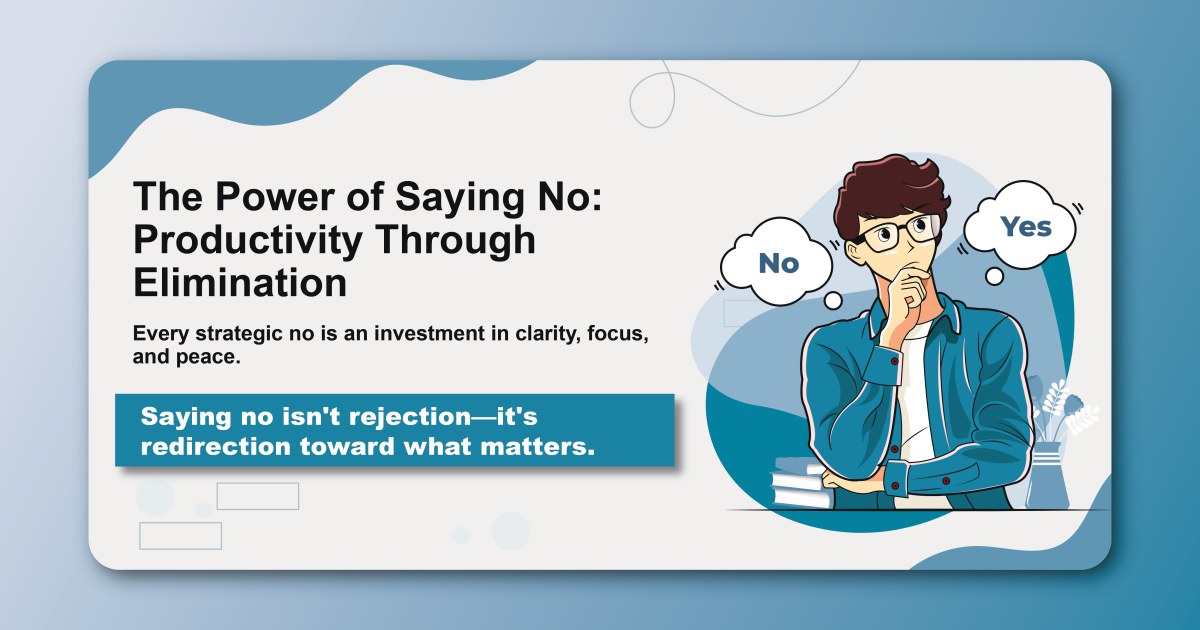
The most successful people in the world aren't necessarily the ones who work the hardest or have the most sophisticated systems. They're the ones who have mastered the art of saying no. They understand that productivity isn't about addition—it's about subtraction. Every yes to one thing is a no to something else, and every no to a distraction is a yes to what truly matters.
This is the power of elimination: the recognition that what you don't do is often more important than what you do.
The Hidden Cost of Yes
The Opportunity Cost Reality
Every commitment you make carries an opportunity cost—the value of the next best alternative you're giving up. When you say yes to:
- A meeting that could have been an email
- A project that doesn't align with your goals
- A social obligation that drains your energy
- A task that someone else could handle better
You're saying no to:
- Deep work on your most important projects
- Time with family and friends
- Rest and recovery
- Opportunities that could transform your career or life
The Commitment Escalation Effect
Most commitments don't stay contained. They expand, requiring more time, energy, and resources than initially anticipated. What starts as a "quick favor" becomes a recurring responsibility. A "simple project" grows into a major undertaking. The initial yes becomes a series of follow-up yeses that compound over time.
The Attention Residue Problem
Every commitment creates what psychologists call "attention residue"—a portion of your mental energy that remains devoted to that commitment even when you're not actively working on it. The more commitments you have, the more fragmented your attention becomes, reducing your ability to focus deeply on any single task.
The Science of Strategic Elimination
Decision Fatigue and Cognitive Load
Limited Mental Resources Your brain has finite cognitive resources. Every decision depletes these resources, making subsequent decisions more difficult. By eliminating non-essential commitments, you preserve mental energy for what matters most.
Cognitive Load Theory Our working memory can only handle a limited amount of information simultaneously. Each commitment adds to your cognitive load, reducing your ability to process information effectively and think clearly.
The Focusing Illusion
The Paradox of Choice Research by psychologist Barry Schwartz shows that having too many options can actually decrease satisfaction and performance. By eliminating choices, you reduce decision paralysis and increase focus on what remains.
Psychological Ownership When you commit to fewer things, you develop stronger psychological ownership of those commitments. This increased ownership leads to better performance and greater satisfaction.
The Compound Effect of No
Immediate Benefits Each no provides immediate relief from potential stress, time commitment, and cognitive load.
Long-term Compounding Over time, the benefits of saying no compound. The energy, time, and attention you save by eliminating non-essential commitments can be reinvested in activities that provide exponential returns.
The Strategic No Framework
Step 1: Clarify Your Priorities
Define Your Core Values Before you can say no effectively, you need to know what you're saying yes to. Identify your core values and use them as a filter for all decisions.
Establish Clear Goals Set specific, measurable goals for different areas of your life. Use these goals to evaluate whether new opportunities align with your intended direction.
Create a Personal Mission Statement Develop a clear statement of your purpose and priorities. This serves as a north star for decision-making and makes it easier to decline opportunities that don't align.
Step 2: Develop Decision Criteria
The 90% Rule Popularized by entrepreneur Derek Sivers, this rule suggests that if an opportunity isn't a "hell yes," it should be a no. Rate opportunities on a scale of 1-100. If it's not a 90 or above, decline it.
The Opportunity Cost Analysis For each potential commitment, explicitly consider what you'll have to give up. If the opportunity cost is higher than the potential benefit, say no.
The Energy Audit Consider not just the time required, but the type of energy. Some activities energize you while others drain you. Prioritize energy-giving activities and eliminate energy-draining ones.
Step 3: Create No Systems
Default to No Make no your default response to new requests. This creates a pause that allows you to evaluate opportunities more objectively.
The 24-Hour Rule Never say yes to significant commitments immediately. Take at least 24 hours to consider the implications and opportunity costs.
Batch Decision-Making Instead of making decisions as they arise, batch similar decisions together. This allows for more consistent and objective evaluation.
The Art of Graceful Refusal
The Anatomy of a Good No
Be Clear and Direct Ambiguous responses leave room for negotiation and follow-up. A clear, direct no is more respectful than a wishy-washy maybe.
Express Appreciation Acknowledge the opportunity and express gratitude for being considered. This maintains relationships while declining the request.
Provide Brief Context You don't need to over-explain, but a brief explanation helps the other person understand your decision and reduces the likelihood of future similar requests.
Offer Alternatives When Appropriate If you want to maintain the relationship, suggest alternative ways to help or recommend someone else who might be a better fit.
No Scripts and Templates
The Simple No "Thank you for thinking of me, but I won't be able to commit to this right now."
The Value-Based No "I appreciate the opportunity, but it doesn't align with my current priorities."
The Capacity No "I'm honored you thought of me, but I'm at capacity and want to give my existing commitments the attention they deserve."
The Redirect No "This sounds like a great opportunity, but it's not the right fit for me. Have you considered [alternative person or solution]?"
Common No Challenges
Fear of Missing Out (FOMO) Remember that saying no to one opportunity creates space for potentially better opportunities. Every successful person has said no to thousands of good opportunities to say yes to a few great ones.
Fear of Disappointing Others Saying no may disappoint someone in the short term, but consistently overcommitting and underdelivering disappoints them more in the long term.
Guilt and Social Pressure Recognize that others may try to pressure you into saying yes. Stay firm in your decision and remember that your first responsibility is to your own priorities and well-being.
Strategic Areas for Elimination
Professional Elimination
Meetings That Don't Add Value
- Decline meetings without clear agendas
- Skip meetings where you're not essential
- Suggest alternatives like email updates or brief one-on-ones
- Batch similar meetings together
Projects Outside Your Expertise
- Focus on work that leverages your unique strengths
- Delegate or decline projects better suited to others
- Avoid the trap of trying to do everything yourself
- Build a reputation for excellence in your core areas
Networking Events Without Purpose
- Attend events that align with your goals
- Skip generic networking events
- Focus on building deeper relationships with fewer people
- Choose quality over quantity in professional connections
Personal Elimination
Social Obligations That Drain Energy
- Decline invitations to events you don't enjoy
- Limit time with people who consistently drain your energy
- Choose social activities that align with your values and interests
- Prioritize relationships that are mutually beneficial
Commitments That Don't Align with Values
- Evaluate volunteer work and causes you support
- Focus your charitable efforts on causes you're passionate about
- Avoid spreading yourself too thin across multiple causes
- Choose depth over breadth in your commitments
Digital Distractions and Information Overload
- Unsubscribe from newsletters and updates you don't read
- Limit social media consumption to specific times
- Avoid news and information that doesn't actionable
- Curate your information diet as carefully as your food diet
Lifestyle Elimination
Activities That Don't Serve Your Goals
- Eliminate or reduce activities that don't contribute to your priorities
- Question traditions and habits that no longer serve you
- Avoid automatic yes responses to recurring commitments
- Regularly audit your activities and eliminate what's not working
Possessions That Add Complexity
- Declutter your physical space regularly
- Avoid acquiring items you don't need or use
- Choose experiences over possessions
- Simplify your environment to reduce decision fatigue
Building Your No Muscle
Week 1: Awareness and Assessment
Current Commitment Audit
- List all your current commitments and responsibilities
- Rate each on importance and energy impact
- Identify commitments that don't align with your priorities
- Note patterns in your yes/no decisions
Tracking Your Responses
- Monitor how often you say yes vs. no to requests
- Note your emotional responses to different types of requests
- Track the actual time and energy cost of your commitments
- Identify your most common reasons for saying yes
Week 2: Practice and Preparation
Develop Your No Scripts
- Write out standard responses for different types of requests
- Practice saying no out loud to build confidence
- Create templates for common situations
- Prepare alternatives to offer when appropriate
Start Small
- Begin with low-stakes requests
- Practice saying no to invitations or requests that don't align with your priorities
- Build confidence before tackling bigger commitments
- Celebrate each successful no
Week 3: Implementation and Refinement
Apply Your Decision Criteria
- Use your established criteria to evaluate new requests
- Implement the 24-hour rule for significant commitments
- Practice the 90% rule for opportunities
- Get comfortable with brief, clear responses
Handle Pushback
- Stay firm when others try to convince you to change your mind
- Practice responding to guilt trips and pressure tactics
- Remember that your priorities are valid
- Maintain relationships while protecting your boundaries
Week 4: System Integration
Create No Systems
- Build no practices into your daily routine
- Set up automatic filters for common requests
- Create systems for evaluating opportunities
- Develop accountability measures for your commitments
Regular Reviews
- Schedule monthly reviews of your commitments
- Assess whether your current yes/no balance is working
- Adjust your criteria based on experience
- Celebrate the positive outcomes of your nos
The Long-term Benefits of Strategic No
Professional Benefits
Increased Focus and Quality By eliminating non-essential commitments, you can focus more deeply on your most important work, leading to higher quality output and better results.
Enhanced Reputation When you selectively choose your commitments, you become known for excellence in your chosen areas rather than being spread too thin across many areas.
Better Opportunities Saying no to good opportunities creates space for great opportunities. The most successful people are highly selective about their commitments.
Reduced Stress and Burnout Eliminating non-essential commitments reduces stress and prevents burnout, allowing you to maintain high performance over longer periods.
Personal Benefits
Improved Relationships By being selective about your commitments, you can give more attention and energy to the relationships that matter most to you.
Better Health and Well-being Saying no to excessive commitments creates space for rest, exercise, and other activities that support your physical and mental health.
Increased Life Satisfaction When your time and energy are aligned with your values and priorities, you experience greater satisfaction and fulfillment.
Enhanced Creativity and Innovation Eliminating distractions and non-essential commitments creates mental space for creative thinking and innovation.
Advanced No Strategies
The Preemptive No
Setting Clear Boundaries Communicate your priorities and availability upfront to reduce the number of inappropriate requests you receive.
Creating Systems That Say No for You Design processes and systems that automatically filter out non-essential requests before they reach you.
Training Others Teach colleagues, friends, and family members your criteria for saying yes, so they can self-filter their requests.
The Collaborative No
Team and Family Alignment Work with your team and family to establish shared priorities and criteria for commitments. This makes it easier to say no to requests that don't align with collective goals.
Mutual Support Create support systems where others can help you say no to inappropriate requests and you can do the same for them.
Your No Action Plan
Immediate Actions (This Week)
- Complete a commitment audit to identify non-essential activities
- Write down your top 3 priorities to use as decision criteria
- Practice saying no to one small request
- Create a simple no script for common situations
Short-term Goals (Next Month)
- Implement the 24-hour rule for significant commitments
- Eliminate 3 non-essential commitments from your schedule
- Create systems for evaluating new opportunities
- Build confidence in your no responses
Long-term Vision (Next Quarter)
- Develop mastery in strategic elimination
- Create a reputation for selective, high-quality commitments
- Build systems that automatically filter opportunities
- Achieve better balance between your commitments and priorities
The power of saying no isn't about being negative or antisocial—it's about being strategic. Every no to a non-essential commitment is a yes to something more important. In a world full of infinite opportunities and constant demands on your time and attention, the ability to say no becomes a superpower.
Start small, build your no muscle gradually, and trust that strategic elimination will create more space for what truly matters in your life. Your future self will thank you for the gift of focused attention and purposeful commitment.
Ready to master the art of strategic no and focus on what truly matters? Set clear priorities and track your commitment alignment with Habityzer and discover how elimination can be more powerful than optimization.