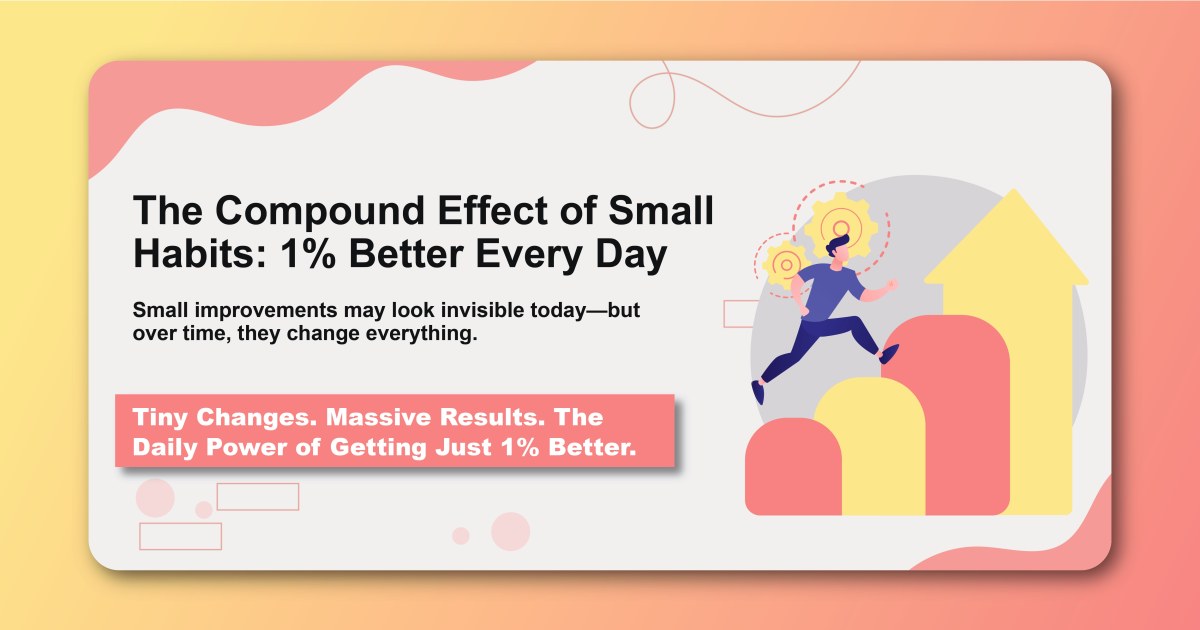
What if I told you that improving just 1% each day could transform your life in ways you never imagined? It sounds too simple, almost trivial. But this is the hidden power of compound habits—small improvements that seem insignificant in the moment but create extraordinary results over time.
The math is stunning: 1% better every day for a year makes you 37 times better. 1% worse every day makes you nearly zero. This isn't just theory—it's the secret behind every major transformation you've ever witnessed.
The Mathematics of Marginal Improvement
The Power of 1.01 vs. 0.99
Let's look at the numbers:
- 1.01^365 = 37.78 (1% better each day for a year)
- 0.99^365 = 0.03 (1% worse each day for a year)
This means that if you can improve by just 1% each day, you'll be nearly 38 times better after a year. But if you decline by 1% each day, you'll be close to zero.
Real-World Translation
What 1% looks like in practice:
- Reading: 1 extra page per day = 365 pages (1-2 books) per year
- Exercise: 1 extra rep or 1 extra minute = significantly improved fitness
- Learning: 10 extra minutes studying = 60+ extra hours per year
- Money: $1 extra saved = $365 saved (plus compound interest)
These tiny improvements are barely noticeable day-to-day, but they compound into life-changing results.
The Science Behind Compound Habits
Why Small Changes Work
Neuroplasticity: Your brain adapts gradually to small changes without triggering resistance Consistency: Tiny habits are easier to maintain, creating reliable neural pathways Momentum: Small wins build confidence and motivation for continued improvement Sustainability: Marginal improvements avoid burnout and overwhelm
The Compound Effect in the Brain
When you make a small improvement:
- Neural pathways strengthen incrementally
- Habit loops become more automatic
- Confidence builds with each success
- Identity gradually shifts to support the new behavior
This creates a positive feedback loop where small improvements make future improvements easier.
Why We Underestimate Small Improvements
The Dramatic Change Myth
Cultural Programming: We're taught to expect dramatic, instant results Media Influence: Stories focus on overnight success, not gradual improvement Impatience: We want immediate gratification and visible progress Comparison: We compare our beginning to others' middle
The Invisibility Problem
Day 1: The change feels insignificant Day 30: Still barely noticeable Day 100: Some improvement but nothing dramatic Day 365: Transformation is undeniable
The compound effect is invisible until it's not. Most people quit before reaching the visible transformation point.
The 1% Better Framework
Daily Improvement Areas
Physical Health:
- Walk 1 extra block
- Do 1 additional push-up
- Drink 1 extra glass of water
- Sleep 10 minutes earlier
Mental Development:
- Read 1 extra page
- Practice 1 new vocabulary word
- Spend 5 more minutes in meditation
- Learn 1 new fact
Professional Growth:
- Send 1 additional networking email
- Practice 1 new skill for 10 minutes
- Organize 1 more file
- Make 1 process improvement
Relationships:
- Express 1 additional gratitude
- Ask 1 thoughtful question
- Give 1 genuine compliment
- Listen 1 minute longer
The Compound Habit Formula
Step 1: Identify Your 1%
- What's the smallest improvement you can make?
- What would 1% better look like in your target area?
- How can you measure this tiny improvement?
Step 2: Make It Daily
- Commit to the 1% improvement every single day
- Build it into your existing routine
- Track your consistency, not just results
Step 3: Trust the Process
- Expect the improvement to feel insignificant
- Focus on the system, not immediate outcomes
- Celebrate the consistency, not just the results
Real-World Compound Habit Examples
The Writer's 1% Rule
Starting Point: Never wrote consistently 1% Improvement: Write 1 additional sentence per day Compound Effect:
- Month 1: 30 extra sentences
- Month 6: 180 extra sentences (several pages)
- Year 1: 365 extra sentences (multiple articles)
- Year 2: Developed into a writing habit with published works
The Athlete's Marginal Gains
Starting Point: Couch potato 1% Improvement: Add 1 minute to daily walk Compound Effect:
- Week 1: 7 extra minutes of walking
- Month 1: 30 extra minutes of walking
- Month 6: 3 extra hours of walking + increased stamina
- Year 1: Completed first 5K race
The Learner's Daily Edge
Starting Point: Felt stagnant in career 1% Improvement: Read 1 extra page of professional development daily Compound Effect:
- Month 1: 1 chapter completed
- Month 6: 3 books completed
- Year 1: 12 books completed + new skills
- Year 2: Promoted due to expanded knowledge
The Compound Effect in Different Life Areas
Health and Fitness
1% Better Examples:
- 1 extra step per day
- 1 extra vegetable serving
- 1 minute longer workout
- 1 minute earlier bedtime
Compound Results:
- Increased energy and vitality
- Better sleep quality
- Improved mood and mental clarity
- Enhanced physical appearance
Career and Professional Development
1% Better Examples:
- 1 extra networking contact
- 1 additional skill practice session
- 1 process improvement
- 1 professional article read
Compound Results:
- Expanded professional network
- Enhanced skill set
- Increased productivity
- Better career opportunities
Relationships and Social Life
1% Better Examples:
- 1 additional thoughtful text
- 1 extra minute of active listening
- 1 more expression of gratitude
- 1 additional quality question
Compound Results:
- Deeper, more meaningful relationships
- Increased social confidence
- Better communication skills
- Stronger support network
Financial Well-being
1% Better Examples:
- Save $1 extra per day
- Cut 1 unnecessary expense
- Invest 1 extra dollar
- Learn 1 new financial concept
Compound Results:
- Increased savings account
- Better financial habits
- Improved investment knowledge
- Enhanced financial security
Overcoming Compound Habit Obstacles
Common Challenges
Challenge 1: It Feels Too Small
- Solution: Trust the mathematics and focus on consistency
- Mindset: "Small improvements are still improvements"
Challenge 2: Results Aren't Visible
- Solution: Track process metrics, not just outcomes
- Mindset: "Every day I'm building my future self"
Challenge 3: Temptation to Do More
- Solution: Stick to your 1% commitment
- Mindset: "Consistency beats intensity"
Challenge 4: Perfectionism
- Solution: Focus on showing up, not perfect execution
- Mindset: "Done is better than perfect"
Staying Consistent with Small Improvements
Daily Tracking:
- Mark your 1% improvement on a calendar
- Use a simple yes/no tracking system
- Celebrate daily victories
Weekly Reviews:
- Assess your consistency rate
- Adjust your 1% target if needed
- Plan for upcoming challenges
Monthly Celebrations:
- Acknowledge your progress
- Calculate your compound improvements
- Set your next 1% target
The Compound Effect Mindset
Patience Over Perfection
Long-term Thinking:
- Focus on the person you're becoming
- Trust the process over immediate results
- Embrace the journey of gradual improvement
Systems Over Goals:
- Build systems that create 1% improvements
- Focus on inputs, not just outputs
- Create sustainable processes
Identity-Based Compound Habits
Identity Shifts:
- "I am someone who improves daily"
- "I am committed to consistent growth"
- "I am patient with the process"
- "I am building my future self"
Behavioral Alignment:
- Act in alignment with your improving identity
- Make decisions that support compound growth
- Choose consistency over intensity
Measuring Your Compound Effect
Tracking Systems
Simple Metrics:
- Days completed (consistency)
- Streak length (momentum)
- Weekly totals (accumulation)
- Monthly progress (compound visibility)
Advanced Metrics:
- Rate of improvement over time
- Compound growth calculations
- Comparative analysis (month to month)
- Habit strength indicators
Milestone Celebrations
30-Day Mark: Celebrate establishing consistency 90-Day Mark: Acknowledge habit formation 365-Day Mark: Celebrate transformation Multi-Year: Recognize life-changing compound results
Building Your Compound Habit System
Phase 1: Selection (Days 1-7)
Choose Your 1% Improvement:
- Pick one area for focus
- Define your specific 1% better
- Make it measurable and achievable
- Connect it to your values
Examples:
- Health: Walk 1 extra block daily
- Learning: Read 1 extra page daily
- Career: Practice 1 skill for 10 minutes daily
- Relationships: Express 1 gratitude daily
Phase 2: Implementation (Days 8-30)
Daily Practice:
- Perform your 1% improvement every day
- Track your consistency
- Adjust if the improvement is too large or small
- Focus on showing up, not perfect execution
Weekly Assessment:
- Review your consistency rate
- Identify obstacles and solutions
- Celebrate your commitment
- Plan for the following week
Phase 3: Compound Acceleration (Days 31-90)
Building Momentum:
- Maintain your 1% improvement
- Notice how it's becoming easier
- Resist the urge to dramatically increase
- Trust the compound process
Monthly Reviews:
- Calculate your cumulative improvement
- Acknowledge the compound effect
- Plan for continued consistency
- Consider adding a second 1% habit
Phase 4: Transformation (Days 91-365)
Compound Results:
- Visible improvements become apparent
- Habit feels natural and automatic
- Identity shifts to support the behavior
- Confidence builds from consistent success
Annual Assessment:
- Calculate your total compound improvement
- Celebrate your transformation
- Plan your next compound habit
- Share your success with others
Common Compound Habit Mistakes
Mistake 1: Starting Too Big
Problem: Choosing improvements that are too large to maintain Solution: Start smaller than you think necessary
Mistake 2: Expecting Immediate Results
Problem: Getting discouraged when changes aren't immediately visible Solution: Focus on consistency and trust the compound process
Mistake 3: Inconsistency
Problem: Doing the improvement sporadically instead of daily Solution: Prioritize showing up over perfect execution
Mistake 4: Adding Too Many Habits
Problem: Trying to improve multiple areas simultaneously Solution: Master one compound habit before adding another
The Long-Term Vision
Year 1: Foundation Building
Focus: Establishing consistency and building the habit Results: Noticeable improvements in chosen area Identity: "I am someone who improves daily" Confidence: Increased belief in ability to change
Year 2: Compound Acceleration
Focus: Maintaining consistency while results compound Results: Significant transformation becomes visible Identity: "I am someone who achieves through consistency" Confidence: Strong belief in compound improvement
Year 3 and Beyond: Mastery
Focus: Leveraging compound habits for life transformation Results: Extraordinary results from consistent small improvements Identity: "I am someone who transforms through daily practice" Confidence: Unshakeable faith in the power of compound growth
Your Compound Habit Action Plan
Week 1: Foundation
Day 1-2: Choose your 1% improvement area Day 3-4: Define your specific daily improvement Day 5-7: Begin daily practice and tracking
Week 2: Consistency
Focus: Showing up every day regardless of motivation Challenge: Resist the urge to do more than 1% Success: Celebrate daily completion
Week 3: Rhythm
Focus: Making the improvement feel natural Challenge: Maintain consistency during busy days Success: Notice reduced friction in starting
Week 4: Compound Awareness
Focus: Recognizing cumulative improvements Challenge: Trust the process despite slow visible progress Success: Celebrate one month of consistency
The compound effect isn't just about getting better—it's about becoming the type of person who gets better every day. It's about understanding that small, consistent improvements create extraordinary results over time.
Remember: You don't need to be great to get started, but you need to get started to be great. Your 1% better today is building your extraordinary tomorrow.
Ready to harness the power of compound habits? Start tracking your 1% daily improvements with Habityzer and discover how small changes create extraordinary transformations.