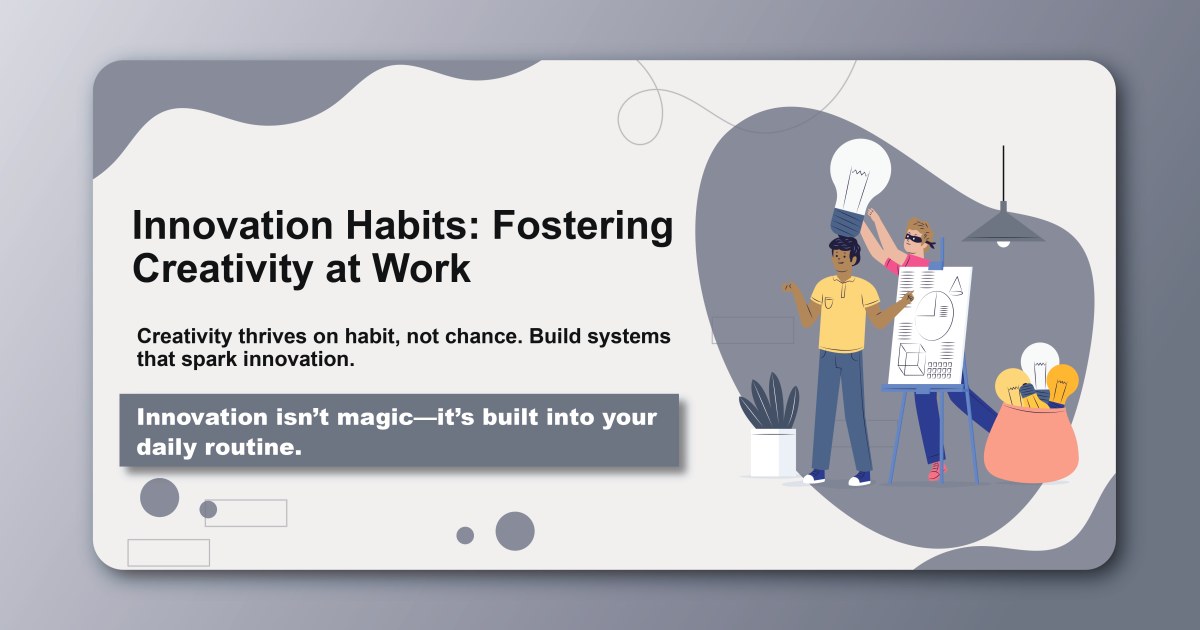
Innovation is no longer a luxury reserved for specialized roles or departments—it's become essential for professional success across all industries and functions. In rapidly changing markets, organizations need employees who can think creatively, generate novel solutions, and adapt to new challenges. Yet many professionals feel stuck in routine thinking patterns, struggling to generate fresh ideas or approach problems from new angles. The key to unlocking innovation lies not in waiting for lightning strikes of inspiration but in developing consistent daily habits that foster creative thinking and breakthrough solutions.
Creative thinking is often misunderstood as a mystical talent that some people possess and others don't. In reality, innovation is a skill that can be developed through deliberate practice and the right environmental conditions. The most innovative professionals have learned to create habits and systems that regularly produce creative insights, fresh perspectives, and novel solutions to complex challenges.
Innovation habits work by creating conditions that allow your brain to make new connections, explore different possibilities, and break free from conventional thinking patterns. These habits include practices for gathering diverse inputs, creating space for reflection and ideation, experimenting with new approaches, and building systems that capture and develop creative insights. When applied consistently, these habits transform innovation from a rare occurrence into a regular part of your professional practice.
The modern workplace demands more innovation than ever before. Digital transformation, competitive pressures, and changing customer expectations require continuous innovation in processes, products, services, and approaches. Professionals who develop strong innovation habits become valuable assets to their organizations, driving improvements, solving complex problems, and identifying new opportunities for growth and success.
This comprehensive guide explores the daily habits that transform innovation from an occasional spark into a consistent capability. Whether you're in a creative field or a more traditional role, these habits will help you develop the creative thinking skills that drive professional success and organizational impact.
The Foundation of Innovation
Understanding Innovation in the Workplace
Innovation Beyond Products Innovation applies to processes, services, solutions, and approaches, not just products or technologies.
Creative Problem-Solving Innovation often emerges from creative approaches to existing challenges and problems.
Incremental and Breakthrough Innovation Innovation includes both small improvements and revolutionary changes.
Collaborative Innovation The best innovations often result from combining diverse perspectives and expertise.
Innovation Principles
Curiosity and Questioning Innovation begins with curiosity and the willingness to question assumptions and conventional wisdom.
Experimentation and Risk-Taking Innovation requires experimentation and calculated risk-taking to explore new possibilities.
Learning from Failure Innovation involves learning from failures and iterating toward better solutions.
Diverse Perspectives Innovation benefits from diverse inputs, experiences, and viewpoints.
Daily Creative Thinking Habits
Curiosity and Exploration
Question Everything Develop the habit of questioning assumptions and exploring alternative possibilities.
Questioning Practices:
- Ask "why" and "what if" questions regularly
- Challenge conventional wisdom and standard approaches
- Explore the reasoning behind existing processes
- Question your own assumptions and biases
- Seek to understand different perspectives and viewpoints
Diverse Input Gathering Regularly expose yourself to diverse sources of information and inspiration.
Input Strategies:
- Read outside your field and industry
- Listen to podcasts and watch videos on various topics
- Attend conferences and events outside your area
- Engage with people from different backgrounds and industries
- Explore art, science, and culture for inspiration
Observation and Pattern Recognition Develop skills in observing patterns and connections across different domains.
Observation Practices:
- Notice patterns in your work and environment
- Look for connections between seemingly unrelated concepts
- Observe how different industries solve similar problems
- Pay attention to customer needs and pain points
- Study successful innovations and their underlying principles
Ideation and Brainstorming
Daily Idea Generation Set aside time each day for generating and capturing ideas.
Idea Generation Practices:
- Keep an idea journal or digital capture system
- Set daily or weekly idea generation goals
- Use prompts and triggers to stimulate thinking
- Practice free-writing or mind mapping
- Combine and build on existing ideas
Creative Thinking Techniques Use structured techniques to enhance creative thinking.
Thinking Techniques:
- Brainstorming and mind mapping
- Reverse thinking and assumption challenging
- Analogical thinking and metaphors
- SCAMPER technique (Substitute, Combine, Adapt, Modify, Put to another use, Eliminate, Reverse)
- Six thinking hats method
Idea Development Develop systems for capturing, evaluating, and developing ideas.
Development Strategies:
- Create idea banks and repositories
- Use criteria to evaluate and prioritize ideas
- Develop concepts through iterative refinement
- Seek feedback on ideas from others
- Test and prototype promising concepts
Creative Environment Design
Physical Environment
Inspiring Spaces Create physical spaces that inspire creativity and innovation.
Space Design Elements:
- Use natural light and plants to enhance mood
- Include visual stimulation and inspiration
- Create flexible spaces for different types of thinking
- Eliminate distractions and clutter
- Incorporate movement and change of scenery
Creative Tools and Materials Provide yourself with tools and materials that support creative thinking.
Creative Tools:
- Whiteboards and flip charts for visual thinking
- Sticky notes and markers for ideation
- Digital tools for mind mapping and concept development
- Prototyping materials for testing ideas
- Books, magazines, and inspiration resources
Mental Environment
Psychological Safety Create mental environments that support creative risk-taking.
Safety Practices:
- Embrace failure as a learning opportunity
- Avoid self-criticism during ideation phases
- Separate idea generation from evaluation
- Celebrate creative attempts regardless of outcomes
- Create supportive relationships with creative colleagues
Mindset and Attitude Develop mindsets and attitudes that support innovation.
Innovation Mindsets:
- Growth mindset focused on learning and improvement
- Abundance mindset that sees opportunities everywhere
- Collaborative mindset that values diverse perspectives
- Experimental mindset that enjoys testing and trying
- Optimistic mindset that believes in positive outcomes
Collaboration and Co-creation
Team Innovation
Collaborative Ideation Engage in collaborative ideation and problem-solving with others.
Collaboration Practices:
- Organize brainstorming sessions with diverse participants
- Use structured innovation workshops and sessions
- Create cross-functional innovation teams
- Facilitate idea-building and concept development
- Encourage wild ideas and unconventional thinking
Diverse Perspective Integration Actively seek and integrate diverse perspectives into innovation efforts.
Diversity Strategies:
- Include people from different departments and functions
- Seek input from various levels of the organization
- Invite external perspectives and expertise
- Consider different cultural and generational viewpoints
- Balance introverted and extroverted thinking styles
Innovation Networks Build networks of creative and innovative people.
Network Building:
- Connect with innovators in your organization
- Join innovation communities and groups
- Attend creative and innovation events
- Participate in hackathons and innovation challenges
- Build relationships with creative professionals
Customer-Centered Innovation
Customer Insight Gathering Regularly gather insights about customer needs and experiences.
Insight Practices:
- Conduct regular customer interviews and surveys
- Observe customer behavior and usage patterns
- Study customer complaints and feedback
- Analyze customer journey maps and touchpoints
- Engage with customers through social media and forums
Empathy and Understanding Develop deep empathy and understanding of customer perspectives.
Empathy Building:
- Use design thinking approaches to understand customers
- Create customer personas and empathy maps
- Experience your product or service as a customer
- Spend time with customers in their environment
- Practice active listening and observation
Experimentation and Prototyping
Testing and Validation
Rapid Prototyping Develop habits of rapid prototyping and testing ideas.
Prototyping Practices:
- Create quick, low-cost prototypes
- Test concepts with real users and stakeholders
- Iterate based on feedback and learning
- Use digital tools for rapid concept development
- Build minimum viable products (MVPs)
Experimentation Mindset Approach innovation with an experimental mindset.
Experimental Approaches:
- Design experiments to test hypotheses
- Measure and analyze results systematically
- Learn from both successes and failures
- Adjust approaches based on evidence
- Scale successful experiments
Failure as Learning Treat failures as valuable learning opportunities.
Learning from Failure:
- Analyze what went wrong and why
- Extract lessons and insights from failures
- Share failure stories and learnings with others
- Use failure to improve future approaches
- Celebrate intelligent failures and learning
Implementation and Scaling
Innovation Implementation Develop skills for implementing and scaling innovations.
Implementation Strategies:
- Create detailed implementation plans
- Identify and address potential obstacles
- Build support and buy-in from stakeholders
- Allocate necessary resources and support
- Monitor progress and adjust as needed
Change Management Develop capabilities for managing innovation-related change.
Change Management:
- Communicate the value and benefits of innovations
- Address resistance and concerns proactively
- Provide training and support for new approaches
- Create feedback loops for continuous improvement
- Celebrate innovation successes and milestones
Innovation Leadership
Leading Innovation
Innovation Culture Building Build cultures that support and encourage innovation.
Culture Building:
- Model innovative thinking and behavior
- Reward creative attempts and risk-taking
- Create psychological safety for experimentation
- Allocate time and resources for innovation
- Recognize and celebrate innovative contributions
Innovation Facilitation Develop skills for facilitating innovation in others.
Facilitation Techniques:
- Guide brainstorming and ideation sessions
- Ask powerful questions that stimulate thinking
- Help others overcome creative blocks
- Provide resources and support for innovation
- Connect people with complementary skills
Innovation Advocacy Advocate for innovation within your organization.
Advocacy Strategies:
- Build business cases for innovation initiatives
- Communicate innovation benefits to leadership
- Create innovation champions and supporters
- Share innovation success stories
- Demonstrate the value of creative approaches
Personal Innovation Development
Continuous Learning Continuously develop your innovation and creative thinking skills.
Learning Approaches:
- Study innovation methodologies and frameworks
- Learn from successful innovators and entrepreneurs
- Practice creative thinking exercises and techniques
- Attend innovation workshops and training
- Experiment with new approaches and methods
Innovation Reflection Regularly reflect on your innovation practices and outcomes.
Reflection Practices:
- Review your innovation successes and failures
- Analyze what conditions led to creative breakthroughs
- Assess the effectiveness of your innovation habits
- Identify areas for improvement and development
- Set goals for enhancing your innovation capabilities
Sustaining Innovation
Long-term Innovation Habits
Innovation Discipline Develop the discipline to maintain innovation habits over time.
Discipline Strategies:
- Schedule regular time for creative thinking
- Set innovation goals and metrics
- Track your idea generation and development
- Maintain creative practices even during busy periods
- Commit to continuous innovation improvement
Innovation Energy Management Manage your energy to maintain creative capacity.
Energy Management:
- Recognize your peak creative times
- Take breaks to recharge creative energy
- Vary your routine to stimulate new thinking
- Engage in activities that inspire creativity
- Maintain work-life balance to prevent burnout
Innovation Community Build and maintain communities that support your innovation efforts.
Community Building:
- Join innovation groups and communities
- Create innovation partnerships and collaborations
- Share your innovations and learn from others
- Participate in innovation challenges and competitions
- Contribute to innovation knowledge and resources
Innovation is not a mysterious talent but a learnable skill that can be developed through consistent daily habits. The practices outlined in this guide provide a comprehensive framework for fostering creativity and generating breakthrough ideas in your professional life. Remember that innovation thrives in environments that encourage experimentation, celebrate learning, and value diverse perspectives.
The key to developing innovation habits is to start small, be consistent, and create conditions that support creative thinking. Whether you're solving complex problems, improving processes, or developing new products and services, these habits will help you unlock your creative potential and drive meaningful innovation in your work.
Innovation is becoming increasingly important in all roles and industries. By developing strong innovation habits, you position yourself as a valuable contributor who can adapt to change, solve complex problems, and create new opportunities for success. The investment in innovation skills pays dividends throughout your career and creates lasting value for your organization and customers.
Ready to unlock your creative potential and drive innovation at work? Start building your innovation habits with Habityzer and discover how consistent creative practices can transform your problem-solving abilities and professional impact.