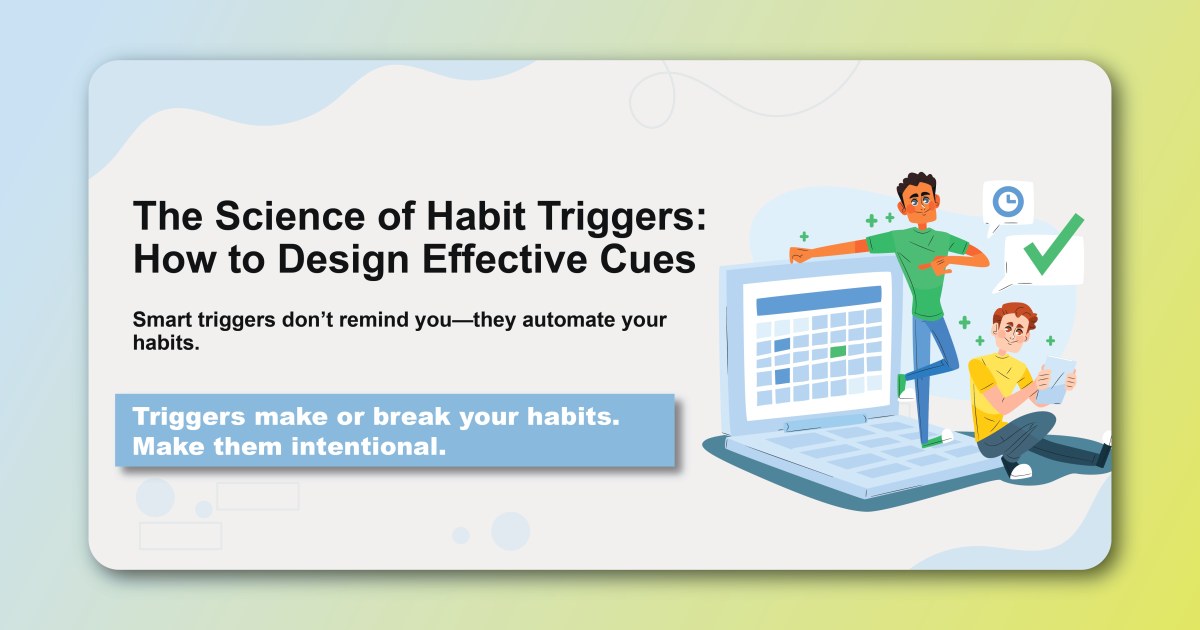
Every habit begins with a trigger—a cue that signals your brain to initiate a behavior. Yet most people leave their triggers to chance, wondering why their habits don't stick. The secret lies in understanding the science behind how triggers work and deliberately designing cues that make good habits inevitable.
In this comprehensive guide, you'll discover how to engineer your environment and design triggers that turn desired behaviors into automatic responses.
The Neuroscience of Habit Triggers
How Your Brain Processes Cues
When you encounter a habit trigger, your brain goes through a rapid sequence:
- Cue Detection: Sensory systems recognize the trigger
- Pattern Recognition: Brain matches cue to stored habit patterns
- Expectation Formation: Brain anticipates the reward from the habit
- Behavioral Activation: Motor systems prepare for the habitual response
This entire process happens in milliseconds, often before conscious awareness.
The Role of the Basal Ganglia
The basal ganglia, your brain's habit center, becomes increasingly sensitive to triggers as habits strengthen. Research shows that:
- Strong triggers activate the basal ganglia more reliably
- Weak triggers require more conscious effort to initiate behavior
- Consistent triggers create stronger neural pathways
- Multiple triggers increase the probability of habit execution
The Five Types of Habit Triggers
1. Environmental Triggers
Physical cues in your surroundings that signal behavior.
Examples:
- Seeing workout clothes laid out → Exercise
- Smell of coffee → Morning routine
- Clean desk → Productive work
- Book on nightstand → Reading
Why They Work:
- Constant presence in your environment
- Processed by unconscious visual system
- Create automatic associations
- Reduce decision fatigue
2. Time-Based Triggers
Specific times or time intervals that initiate habits.
Examples:
- 6:00 AM → Morning meditation
- Lunch break → Quick walk
- 9:00 PM → Evening wind-down
- Every 2 hours → Hydration break
Why They Work:
- Leverage natural circadian rhythms
- Create predictable patterns
- Reduce need for decision-making
- Build on existing time structures
3. Social Triggers
People or social situations that prompt habitual behaviors.
Examples:
- Seeing a colleague → Greeting ritual
- Family dinner → Gratitude practice
- Walking with friend → Exercise motivation
- Group meeting → Note-taking habit
Why They Work:
- Tap into social motivation
- Create accountability pressure
- Leverage mirror neurons
- Build on relationship patterns
4. Emotional Triggers
Internal emotional states that initiate behavioral responses.
Examples:
- Feeling stressed → Deep breathing
- Feeling grateful → Journaling
- Feeling energized → Physical activity
- Feeling overwhelmed → Prioritization
Why They Work:
- Always available internal cues
- Strong motivational force
- Create self-regulation patterns
- Build emotional intelligence
5. Contextual Triggers
Specific situations or contexts that prompt behaviors.
Examples:
- Sitting in car → Seatbelt habit
- Opening laptop → Posture check
- Entering kitchen → Hydration
- Feeling hungry → Healthy snack choice
Why They Work:
- Leverage existing routines
- Create situation-specific responses
- Build on natural transitions
- Reduce cognitive load
The CRISP Framework for Trigger Design
C - Consistent
Principle: Triggers must be reliable and regular Application:
- Use the same cue every time
- Maintain consistent timing
- Keep environmental cues in the same location
- Establish predictable patterns
R - Relevant
Principle: Triggers should logically connect to the behavior Application:
- Match trigger to the natural context of the habit
- Use cues that make sense for the behavior
- Consider the emotional relevance
- Align with your lifestyle and schedule
I - Immediate
Principle: Cues should directly precede the desired behavior Application:
- Minimize delay between trigger and action
- Place cues in the exact location of the habit
- Use triggers that demand immediate response
- Avoid complex trigger sequences
S - Specific
Principle: Triggers should be clear and unambiguous Application:
- Define precise trigger conditions
- Avoid vague or general cues
- Use specific sensory details
- Create binary trigger conditions (either/or)
P - Personal
Principle: Triggers should be meaningful to you Application:
- Choose cues that resonate with your values
- Use triggers that fit your personality
- Leverage your existing preferences
- Consider your unique circumstances
Advanced Trigger Design Techniques
The Trigger Stack
Layer multiple triggers to increase reliability.
Structure: "When I [trigger 1] AND [trigger 2], I will [habit]."
Example:
When I sit at my desk (environmental)
AND it's 9:00 AM (time-based)
AND I feel focused (emotional)
THEN I will start my deep work session
Benefits:
- Increases trigger reliability
- Creates stronger behavioral cues
- Reduces false positives
- Builds robust habit patterns
The Trigger Chain
Create sequences of triggers that build momentum.
Structure: "After trigger 1 → behavior 1 → trigger 2 → behavior 2"
Example:
Alarm goes off → Get out of bed → See workout clothes → Exercise →
Feel energized → Healthy breakfast → Feel accomplished → Plan day
Benefits:
- Creates behavioral momentum
- Links related habits
- Builds comprehensive routines
- Increases overall consistency
The Contextual Trigger Matrix
Design different triggers for different contexts.
Structure:
Context A: Trigger X → Behavior
Context B: Trigger Y → Behavior
Context C: Trigger Z → Behavior
Example:
At home: See journal on nightstand → Write
At work: Lunch break ends → Write
Traveling: Open laptop → Write
Benefits:
- Maintains habits across contexts
- Prevents context-dependent failure
- Increases flexibility
- Builds habit resilience
Environmental Design for Trigger Effectiveness
The Four Laws of Trigger Design
Law 1: Make It Obvious
- Place triggers in plain sight
- Use bright colors or contrasting elements
- Position cues at eye level
- Create visual reminders
Law 2: Make It Attractive
- Bundle triggers with pleasant elements
- Use appealing visual design
- Associate triggers with positive emotions
- Create aesthetic appeal
Law 3: Make It Easy
- Reduce friction between trigger and behavior
- Place triggers close to the action
- Remove obstacles from the trigger path
- Simplify the trigger-to-behavior sequence
Law 4: Make It Satisfying
- Include immediate positive feedback
- Create micro-rewards for noticing triggers
- Build in celebration moments
- Track trigger responsiveness
Environmental Trigger Audit
Evaluate your current environment for trigger effectiveness:
Positive Triggers Assessment:
- What good habit triggers currently exist?
- How visible and accessible are they?
- Which triggers work most reliably?
- Where could you add more effective cues?
Negative Triggers Assessment:
- What bad habit triggers are present?
- How can you remove or modify them?
- Which triggers sabotage your goals?
- What environmental changes would help?
Digital Triggers and Technology
Smart Trigger Systems
Phone-Based Triggers:
- Custom notification sounds for different habits
- Location-based reminders
- Time-based alerts with specific messaging
- App-based visual cues
Wearable Triggers:
- Vibration patterns for habit reminders
- Heart rate-based activity prompts
- Step count triggers for movement
- Sleep cycle-based morning cues
Smart Home Triggers:
- Automated lighting changes
- Music playlists for different activities
- Voice assistant reminders
- Environmental sensor responses
Digital Trigger Best Practices
Avoid Trigger Fatigue:
- Limit the number of digital reminders
- Use varied notification styles
- Rotate trigger types periodically
- Monitor trigger effectiveness
Personalize Digital Cues:
- Customize notification messages
- Use personally meaningful sounds
- Set context-appropriate triggers
- Adjust based on your schedule
Troubleshooting Common Trigger Problems
Problem 1: Trigger Invisibility
Symptoms: Consistently missing or ignoring cues Solutions:
- Increase trigger visibility
- Use multiple sensory channels
- Change trigger location
- Add reinforcing cues
Problem 2: Trigger Overload
Symptoms: Too many cues leading to confusion Solutions:
- Simplify trigger environment
- Focus on one trigger per habit
- Remove competing cues
- Prioritize most important triggers
Problem 3: Context Dependency
Symptoms: Triggers only work in specific situations Solutions:
- Create multiple context-specific triggers
- Build portable trigger systems
- Develop internal trigger sensitivity
- Practice trigger recognition
Problem 4: Trigger Habituation
Symptoms: Becoming immune to previously effective cues Solutions:
- Rotate trigger types periodically
- Increase trigger intensity or novelty
- Add new sensory elements
- Refresh trigger associations
The Psychology of Trigger Effectiveness
Attention and Trigger Processing
Selective Attention: Your brain filters millions of potential cues Trigger Salience: Effective triggers stand out from background noise Expectation Effects: Anticipating triggers increases their effectiveness Habituation: Repeated exposure can reduce trigger impact
Emotional Triggers and Motivation
Emotional Arousal: Feelings amplify trigger effectiveness Positive Associations: Pleasant emotions strengthen trigger-behavior links Stress Response: High stress can increase trigger sensitivity Reward Anticipation: Expecting positive outcomes enhances trigger power
Measuring Trigger Effectiveness
Trigger Performance Metrics
Response Rate: How often you respond to the trigger Response Time: How quickly you act after noticing the trigger Consistency: How reliably the trigger works across contexts Sustainability: How well the trigger maintains effectiveness over time
Trigger Optimization Process
Weekly Assessment:
- Which triggers worked most reliably?
- What circumstances caused trigger failures?
- How can you improve trigger visibility?
- What new triggers should you test?
Monthly Review:
- Overall trigger effectiveness trends
- Identification of trigger habituation
- Environmental changes needed
- Trigger system updates
Building Your Personal Trigger System
Step 1: Habit Prioritization
- Identify your most important habits
- Choose 1-3 habits to focus on initially
- Consider habit difficulty and importance
- Plan for gradual system expansion
Step 2: Trigger Selection
- Choose primary trigger type for each habit
- Design backup triggers for reliability
- Ensure triggers fit your lifestyle
- Test trigger effectiveness
Step 3: Environmental Setup
- Modify your environment for trigger effectiveness
- Remove competing or contradictory cues
- Add supporting environmental elements
- Create trigger-rich contexts
Step 4: System Implementation
- Start with one trigger-habit pair
- Monitor and adjust based on results
- Gradually add additional triggers
- Maintain and optimize over time
Common Trigger Myths Debunked
Myth 1: "One Trigger Is Enough"
Reality: Multiple, layered triggers increase reliability and effectiveness
Myth 2: "Triggers Should Be Subtle"
Reality: Obvious, prominent triggers work better than subtle ones
Myth 3: "Internal Triggers Are Better"
Reality: External triggers are more reliable, especially for new habits
Myth 4: "Triggers Work Immediately"
Reality: Trigger effectiveness improves with repetition and optimization
The Future of Trigger Design
As technology advances, trigger design becomes increasingly sophisticated:
AI-Powered Triggers: Personalized cues based on behavior patterns Biometric Triggers: Physiological signals that prompt optimal behaviors Predictive Triggers: Anticipatory cues based on context and history Adaptive Triggers: Self-adjusting cues that optimize over time
Your Trigger Design Action Plan
Ready to build more effective habit triggers? Start with this systematic approach:
Week 1: Assessment
- Audit your current trigger environment
- Identify your most important habits
- Note current trigger effectiveness
- Plan trigger improvements
Week 2: Design
- Create specific triggers for priority habits
- Apply the CRISP framework
- Set up environmental supports
- Test initial trigger effectiveness
Week 3: Implementation
- Begin using new trigger system
- Monitor response rates and consistency
- Make immediate adjustments
- Track trigger-behavior connections
Week 4: Optimization
- Analyze trigger performance data
- Refine and improve trigger design
- Add supporting environmental elements
- Plan for long-term maintenance
Remember: Great triggers don't just remind you to do something—they make the right choice feel inevitable. By understanding the science behind habit triggers and deliberately designing your cue environment, you can create a system that makes good habits automatic and lasting change effortless.
Ready to design triggers that make habits inevitable? Start building your trigger system with Habityzer and track how environmental cues transform your daily routine.